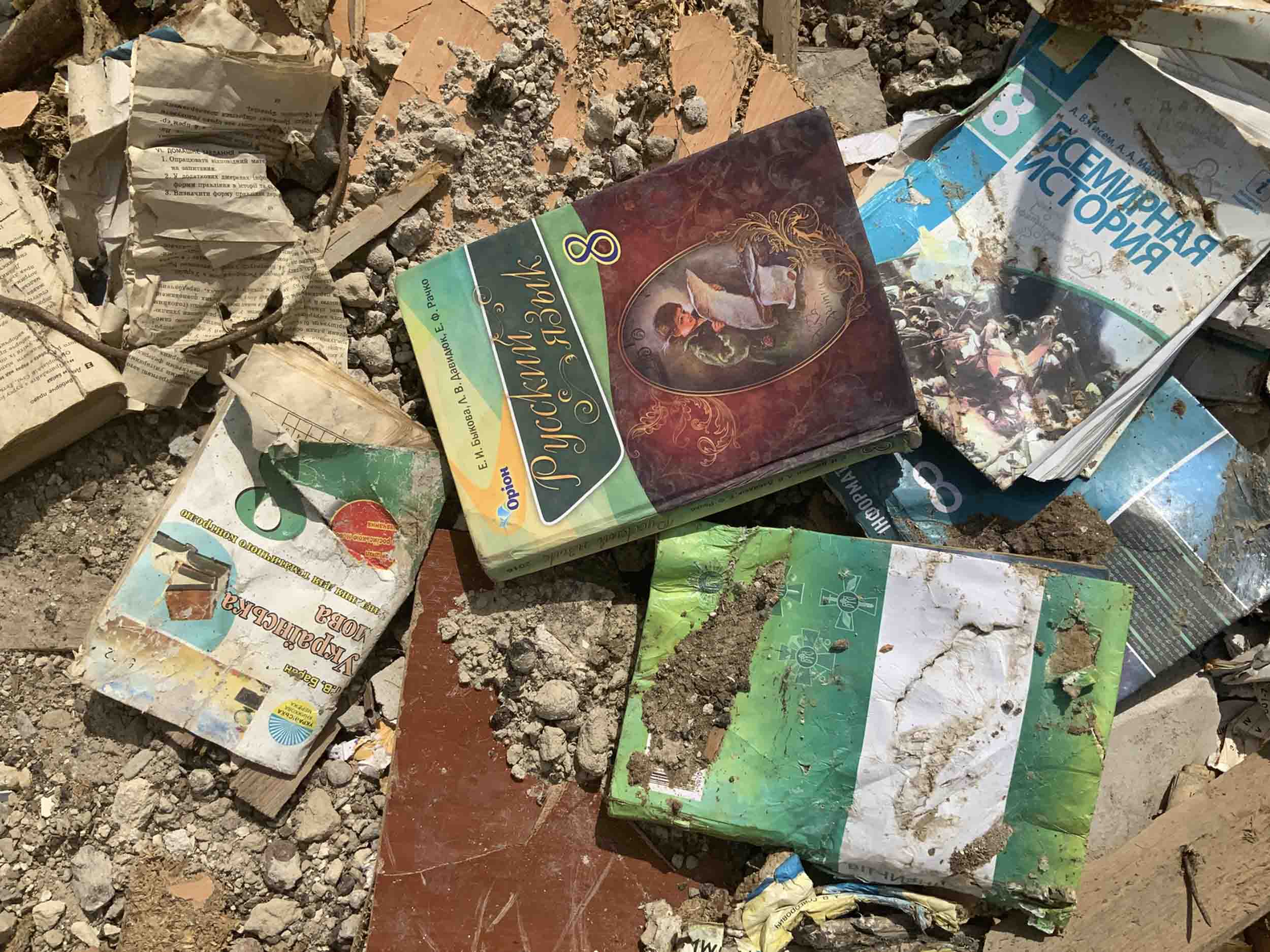
In a pile of rubble in the destroyed Gymnasium No. 47 in Kharkiv (Харьковская гимназия № 47), Ukraine, I picked up a book. The school was, fortunately, not open when it was destroyed by Russia in the early hours of July 04, 2022 (See the archello website and Kanal 24 and Infociti website). It was Day 130 of the Full-Scale Invasion and two months after the Battle of Kharkiv (February to May, 2022) during which, Russian forces first entered the city, and were then eventually driven out by Ukraine.

The ruins of Kharkiv Gymnasium No 47. Photo: the author (Mike Pole).
Gymnasium No. 47 was specialised for (this loosely follows Google Translate from this website ) “training in natural sciences, social sciences, humanities and technology“, with a focus on “Search, selection and development of capable and gifted children, the creation of optimal conditions for the development of natural abilities of students, and the creation of a situation of success for each student and teacher“.

A classroom mural in the destroyed Gymnasium No 47 in Kharkiv. Electrical fittings and window frames were salvaged before this photo was taken. Photo: the author (Mike Pole).
The book I picked up was ‘Pipi Longstockings’, by the Swedish author, Astrid Lindgren. ‘Pipi Longstockings‘ has been translated into many languages – but the version I picked up, was in Ukrainian. It’s the 1977 edition by Veselka (Веселка) — the main Ukrainian children’s publisher based in Kyiv.

A couple of pages inside the book that I picked up in the ruins of Gymnasium No. 47 in Kharkiv: ‘Pippi Longstockings’, by Astrid Lindgren (Пеппі Довгапанчоха. 1977. Веселка). Photo: the author (Mike Pole).
When I recognised what the book was – it triggered an odd connection. Lindgren is famous for the young, pig-tailed character she created, but surely less well-known is that during World War Two, she decided to keep a diary. It was a mixture of newspaper clippings, and Lindgren’s own perceptions about the war, as it happened. It was translated from the Swedish by Sarah Deathm and published as: ‘A World Gone Mad. The Diaries of Astrid Lindgren 1939-45′.
Technically, it was the Soviet Union that was attacking from the east. Germany and the Soviet Union had signed the Molotov-Ribbentrop Treaty, and started the war as allies. When the Germans turned on them, the Soviet ‘Red Army’ drove them back. Lindgren uses the term ‘Soviet Union’ but far more frequently uses ‘Russia’ – the realistic center of power. One of the things that comes through the diary – is her opinion of the Russians, compared with the Germans. She wrote:
“The worst thing is, soon we won’t even be able to wish for a German defeat any more, because the Russians are on the move again. In the last few days they’ve occupied Lithuania, Latvia and Estonia, on sundry pretexts. And a weakened Germany can only mean one thing for us Nordic nations – that we’ll be overrun with Russians. And I think I’d rather say ‘Heil Hitler’ for the rest of my life than have that happen. I can’t think of anything more appalling.”
Yes, one could easily point out that Lindgren wasn’t Jewish, or any one of the other identities the Nazis had ‘othered’. But it seems that, even then, the Russians, or more specifically, the military, had a very bad reputation. As World War Two progressed, Sweden was fortunate enough to not be occupied by either belligerent. Sweden, Lindgren’s home country, was famously ‘neutral’, although infamously did collaborate with Germany (e.g. supplying iron ore and granting troop transit rights).
At the conclusion of the war, Germany lost, and the capital, Berlin, was defeated and occupied by Soviet forces (until it was later partitioned). The results were very unpleasant for much of the civilian population. The savagery of the Red Army – and to be clear, these were not just ‘Russians’, but a mixture of Soviet nations, was appalling. But the general lawless behaviour was basically what Lindgren had feared might come to Sweden.
It was only a few weeks after I read Lindgren’s diary, that I ended up in Kharkiv – and picked up the copy of ‘Pipi Longstockings’. It seemed somehow symbolic that a few weeks after reading Lindgren’s diary, and her fear of Russia’s military – that I should pick up a her book, in the ruins of a school, destroyed by … Russians. As an aside, one of the various ‘reasons’ put out by the Kremlin for invading Ukraine, as that it was protecting Russian-speakers. Odd then, that among other books scattered around the ruins of that school – were text books on learning Russian.
Was the destruction of the school intentional? Of course, if it wasn’t for the Russian invasion, the school would still be there. But was it actually targeted? Specifically, it’s probably hard to say. From my brief visit, it seemed like a direct hit on the school – but the surrounding buildings were fine. The infociti website states “Дві ракети” struck the school. Google Translate can translate this both as “two rockets”, or “two missiles”, depending on how much text is loaded. It makes a difference, because one is much more accurate than the other. For now, I can’t find the details.
However, put into a broader context, it’s clear that Russia targets schools and other educational institutions (and hospitals, sports centers, and so-on) in Kharkiv, and across Ukraine. To quote James Bond (in Ian Fleming’s ‘Goldfinger‘):
“Once is happenstance. Twice is coincidence. Three times is enemy action”.
Keeping that in mind, it’s relevant that Kharkiv Gymnasium No. 46, was also destroyed, on July 10. But Numbers 46 and 47 are just two of many educational facilities hit by Russian weapons. The numbers go well into the zone of ‘Enemy Action’. On September 01, 2022, the Centre for Information Resilience published a report on ‘The systematic targeting of educational infrastructure in Kharkiv‘. They wrote:
“Analysis of the areas surrounding affected educational facilities suggests the shelling was targeted, rather than a by-product of indiscriminate attacks on civilian infrastructure…. there were many instances in which the educational facility was the only building shelled within a radius of 1.5km to 3km.”
Further:
“Among the educational facilities targeted and shelled by the Russian military in Kharkiv were a boarding school for visually impaired students, a 218-year old university library, a university training pool used by olympic athletes, and an almost 100-year old vocational college.”
They also noted that the organisation ‘Eyes on Russia‘, had, between February and July 2022:
“recorded a total of 41 instances of shelling targeting educational institutions in the city of Kharkiv, causing either a partial or complete destruction of a variety of different types of facilities.”
The list included pre-schools, comprehensive schools, specialised schools, vocational colleges, and universities – some of which were targeted more than once.
The deliberate destruction of multiple educational institutions highlights the very different mentality that has developed in Russia. It’s also a reminder that this war is about the destruction of culture and identity – not territory.
I’m sure Astrid Lindgren would agree.
Reference
Lindgren, A. A World Gone Mad. The Diaries of Astrid Lindgren 1939-45. Translated from the Swedish by Sarah Death. With a foreword by Karin Nyman. Pushkin Press, London.