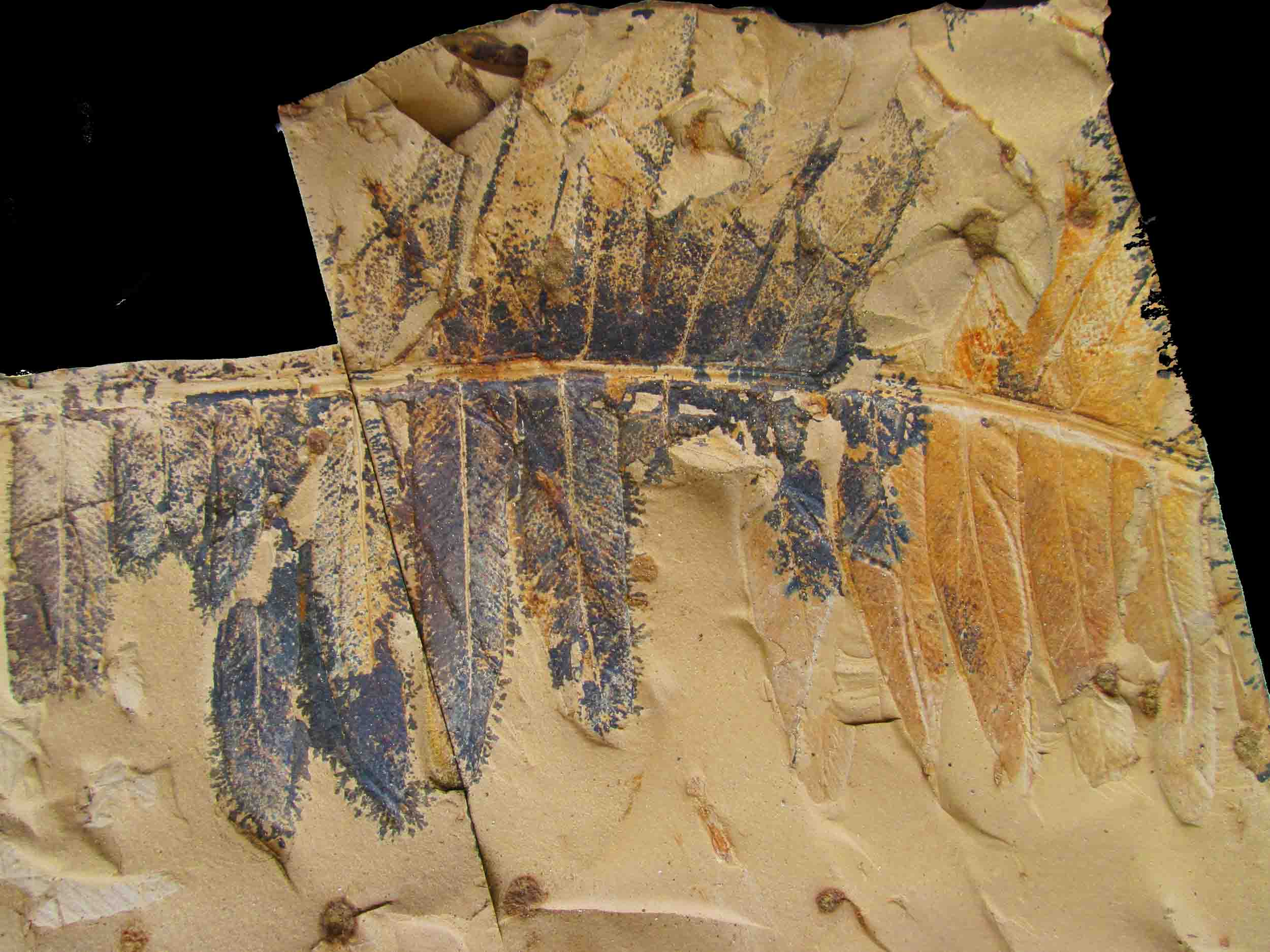
The Jurassic fossil forests at Curio Bay appear to have been overwhelmed by water-lain material, not by air-fall volcanic ash. But the broader location was somewhere on a floodplain adjacent a highland with active volcanoes – so surely the forests were blanketed with ash from time to time?
In the cliff below the lookout is distinctive layer, about 10 mm thick. In 1982, when I was studying the area for my project at Curio Bay, it looked like a coarse sandstone, except that some of the grains ‘twinkled’ as I turned a piece under the sun.

The layer of crystal tuff below the Curio Bay fossil forest lookout. It’s the coarse, slightly speckled layer, level with the top of the New Zealand One Dollar coin. Photo: the author (Mike Pole).
I took a sample back to the University, hunched over a gribdstone, and ground it down to look at it under the microscope (it was a skill that all Geology students were exopected to master). The result confirmed that what I was looking at were the reflective faces of individual, sharp-cornered crystals of feldspar in a more opaque matrix. It was a volcanic ‘crystal tuff’ (‘tuff‘ is volcanic ash). I stuck a pretty clumsy micro-photograph into my report, and it got a further mention (Pole, 2001) as a crystal tuff, “immediately overlying” Curio Bay’s fossil forest layer CBF2 “(and possibly within) its layer of leaf litter”.
This thin ash layer is hardly likely to have destroyed the forest, but the fact that it is preserved means that it was soon covered, intact, by more material. In other words, the centimeter or so of ash fell, and, then, perhaps within hours, it was covered by a flood of volcanic material that swept down the river, and overwhelmed the forest.
A few kilometers away, in the cliffs forming Slope Point, there is an entirely different kind of material. In complete contrast to the sparkly crystal tuff at Curio Bay, it is homogenous and very, very fined-grained (with a cherty or flinty texture), has the slightest pink tinge (note: the hue in these on-line images will be a bit ‘off’), and contains nice plant fossils (see the Featured Image). My professors (either J.D. Campbell, or D.S. Coombs), regarded it as an ‘analcime tuff’. They were both Murihiku Group experts, and were familiar with similar material in it, mostly from the older Triassic strata.
Professor Coombs, in particular, was an expert on ‘zeolites’ – a family of minerals that can form in, and define, low levels of metamorphism (Coombs, 1954). Analcime is one of them. At around the time I was doing my early Curio Bay work, an American researcher, Jim Boles, was spending some time in the Department. He had done his PhD at Otago, a decade before, with Coombs as his advisor. He was back, I presume, for more field work and collaboration (Boles, 1971, 1974, 1991; Boles and Coombs, 1975; Coombs, 1954). Both of these researchers had recognised ‘Vitric and vitric-crystal tuffs’ as being common throughout the Murihiku Group strata – and they had been altered to a range of zeolites, including analcime. So Bole’s expertise on the nature of that pinkish rock was probably in the mix as well.
That pink rock on Slope Point probably started off as a very fine grained ‘vitric’ tuff – composed of shards of volcanic glass (essentially fragments of bubbles). Such material is highly unstable in a chemical sense and some of it would have degraded, or ‘dissolved’ in rainfall. This would have produced the silica in solution, which then impregnated wood to ‘petrify and silicify it. Light metamorphism would have produced the analcime.
Like the crystal tuff, I had a go at making a thin section of it – I was interested t see if I could find any internal structure of the plant fossils within it. But it was like trying to grind down a lump of glass, that stuff was so hard that I think I wore away more of the grind-stone (and my finger tips) than the tuff.
Later, visiting Japanese researchers (Noda et al., 2002), carried out more work on the broader Curio Bay region. They noted that “Hard pink tuff beds occur sporadically throughout the sequence” and under a microscope, showed a “felsic texture without large phenocrysts”.
Thus, crystals, or glass shards (or their presumed altered products) can be used to distinguish two types of volcanic tuff – ‘crystal tuff’ and ‘vitric tuff’ respectively, in the Curio Bay region. In fact, based on over more than a century of research, a three-component system evolved to classify tuffs around the world (Pettijohn, 1957; Pirsson, 1915; O’Brien, 1963; Wentworth and Williams, 1932). It used the proportions of crystals, glass shards, and a third component – microscopic rock fragments. When these dominate, the rock is known as a ‘lithic tuff’.

These ‘whispy’ beds, in the low cliff opposite the Curio Bay Campground, are proably Lithic tuffs that have been deposited in shallow water. Photo: the author (Mike Pole).
Are lithic tuffs present at Curio Bay? The whispy beds of silt-sized material, and probably the coarser beds too, in the low cliffs opposite the Curio Bay Campground, are probably lithic tuffs. In fact, much of the material that overwhelmed each Curio Bay forest, might be ‘lithic tuff’, albeit, redeposited by water. Making the distinction between rocks ground up and weathered by erosion, and those produced by volcanism, would require careful work.
I can empathise, but somebody will need to hunch over a grindstone, and make more thin-sections.
References
Boles, J.R. 1971. Stratigraphy, petrology, mineralogy, and metamorphism of mainly Triassic rocks, Hokonui Hills, Southland, New Zealand. PhD thesis, University of Otago, Dunedin, New Zealand.
Boles, J.R. 1974. Structure, stratigraphy, and petrology of mainly Triassic rocks, Hokonui Hills, Southland, New Zealand. New Zealand Journal of Geology and Geophysics, 17, 337–374.
Boles, J.R. 1991. Diagenesis during folding and uplift of the Southland Syncline, New Zealand. New Zealand Journal of Geology and Geophysics, 34, 253–259.
Boles, J.R. and Coombs, D.S. 1975. Mineral reactions in zeolitic Triassic tuff, Hokonui Hills, New Zealand. Geological Society of America Bulletin, 86, 63–173.
Coombs, D.S. 1954. The nature and alteration of some Triassic sediments from Southland, New Zealand. Transactions of the Royal Society of New Zealand 82: 65-109.
Noda, A., Takeuchi, M., and Adachi, M. 2002. Fan deltaic-to-fluvial sedimentation of the Middle Jurassic Murihiku Terrane, Southland, New Zealand. New Zealand Journal of Geology and Geophysics, 45, 297-312.
O’Brien, R.T. 1963. Classification of tuffs. Journal of Sedimentary Research, 33: 234–235.
Pettijohn, F.J. 1957, Sedimentary rocks: 2nd ed., New York, Harper and Brothers.
Pirsson, L.V., 1915, The microscopical characters of volcanic tuffs–a study for students: Am. Jour. Sci., Ser. 4, v. 40, p. 191-211.
Wentworth, C.K. and Williams, l.L, 1932. The classification and terminology of the pyroclastic rocks. Natl. Acad. Sci. – Natl. Res. Council, 89: 19-53.