Traveling to Lviv
Camouflage nets – in this day and age? As a kid, I grew up, painting camouflage on Second World War model planes. Somehow, I’d thought that level of technology had gone with the coming of the digital age. But then, didn’t we all think that trench-warfare had long-gone too?
Lviv is a wonderful city in the west of Ukraine. Very special in fact – and far enough to the west of the country to be, in September 2024, directly unaffected by hostilities. Mostly. Before I came to Lviv, I hadn’t contacted anyone in advance and I certainly wasn’t sponsored by any aid organisation. Compared with New Zealand and Australia, Ukraine costs maybe half as much. So it’s cheaper, but not free – ‘funding’ came out of my pocket. It wasn’t my first time in Ukraine, but other than passing through the station years before, it was my first time in Lviv. The broader goals of my trip (on a one-way ticket) were fairly simple – spend a winter, put my head down and make an honest contribution, have people around, and by and by, get a better understanding of Ukrainian life and the war.
Fresh off the train from Krakow, I got a ‘capsule’ in the hostel about twenty minutes walk from the town center. Then I read a web site page with some volunteering suggestions, and headed into town. My first choice was ‘New Acropolis’ (Novii Acropol/Новий Акрополь), a location that is mainly a philosophy school. I rang the bell, met Andrii, and thus began my volunteering stint.
Net Weaving
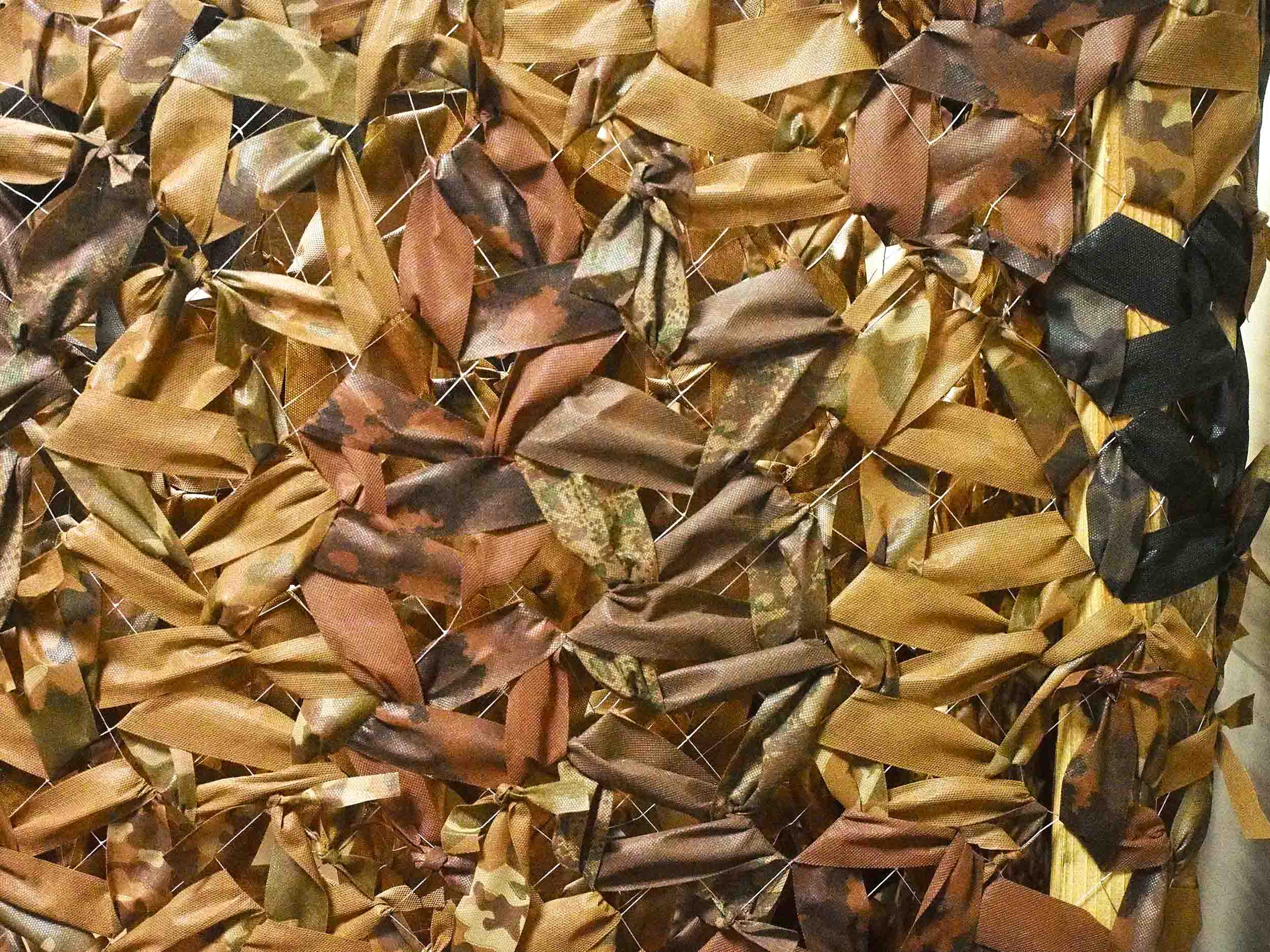
At the center of the New Acropolis workshop stood a wooden frame, over which a fishing net was stretched. The net was the base on which the women wove the camouflage. The women – you say?!!! Yes, it may sound a bit odd to a New Zealand or Australian audience, but Ukraine has a fair amount of traditional division of roles by gender. Its certainly not that Ukrainian women can’t, or won’t do somethings – it’s more that if a bloke is around – it’s expected that he will do the job.
The work the women did, required not just skill, but thinking ahead. (One day there will be some fascinating research on the evolution of camouflage net making techniques – as this war progressed. In some workshops, the strips were tied on to the intersections of the fishing nets).
However, the women weren’t weaving a simple, repeated pattern, but semi-randomly interspersed blobs of other colour. They had to weave around these, but still keep the overall ‘tension’ under control. When I arrived in Ukraine, the leaves on the trees were green – and so was the camouflage material. Then came autumn (which in Ukrainian is ‘listopad’ = ‘leaf fall’), some gold joined the colour spectrum, and that passed into winter. I assumed we would all transit to white material. In fact, we started making two types – the expected white sheets (with dark spots) for snow, but also brown sheets, for the mud. We made to request. The people on the front would tell us what colours and patterns were most useful at that moment.

Camouflage netting woven by the women of New Acropolis, Lviv, Ukraine. Left, autumn colurs, right, winter colours. Photos: the author (Mike Pole)
Cutting strips
The women wove strips of various colours: light green, dark green, light brown, dark brown, white….. The women would let me know which colours they were going to need. They came in stacks of narrow rolls. Each roll was about 30 mm wide, and 30 cm in diameter, but needed to be cut into lengths of about a meter each. One of my side jobs was to cut them to weavable length.
For this, a somewhat medieval-looking, wooden machine has been built – and was a perfect solution to the task. Slide the roll onto a shaft, clip the end the material to the windmill, spin the handle for a while, then use a craft knife to slice into two piles of strips. Then – while the strips were still in a coherent stack – Each strip then needed a scissor cut at each end to give the weavers something to tie-off with. The completed strips were stuffed into a carton, and they were ready for weaving.
Most of my colleagues spoke no English, although surprised me on occasion by coming out with a little. They were more likely to know some German – although sometimes limited to those phrases we must have all heard as kids: “Achtung!” “Handes-hoch!” I did try to learn Ukrainian, although from a position of knowing some Russian. This involved a metaphorical mine-field. Every time I used a Russian word (aka the ‘wrong’ word!) – the error was immediately pointed out. Some of those women grew up speaking Ukrainian, some Russian. But with the full-scale war, they were making a choice.
Cutting sheets
My main job was quite different. I would turn pre-printed material into ‘rough and ready’ camouflage sheets. Basically, just cutting holes, for the air and rain to pass through. The camo-canvas would come in big, head-high rolls. A truck would drop off a load in the street, and they were big and heavy enough that one person could only just carry them up the stairs to the workshop. Once inside, two people were needed to wind off eight meters – this meant eight turns of the camo roll onto a wood and wire frame. This camo material was then slid off, and laid out on a metal table, into which 143 crescent-shaped holes had been cut. The sheet was carefully positioned, and then a matching upper metal sheet was placed on top. Then, using a fishing knife, my job was brute force, over and over again. Simply puncture through the eight layers of canvas in one of those holes, and then cut around the curve.
I got into a habit of sharpening the knife after every sheet. At the start of the day, I used a file on the point of the knife. Eventually I could mostly puncture all eight layers of canvas, and make the cut in one motion, and do the 143 holes in 5-7 minutes. The main danger on my mind, was to miss-stab, and have the knife somehow flick into my eye, or worse, someone else’s (I did stab myself lightly in the stomach a few times!).
Here was the catch. Sheet-cutting could be a one-person job (it could also be two, with someone working on the other side of the table), but that upper sheet of metal was impossible to maneuver by one person. That meant, one of the women, quietly getting on with her weaving, was constantly interrupted to come and help lift it off, and fold it up. The perforated sheets were then stacked, and eventually headed into another room. There, someone skilled on a sewing machine, sewed two together into a much bigger sheet. Finally, woven nets and perforated sheets were folded or rolled up, and carefully packed – with a range of sweets ‘hidden’ through them, as morale-boosters. The stuff headed east by the postal network, and then to the front by other means. Sometimes we would get photos back from the front, with the soldiers acknowledging receipt, by standing in front of our delivery. Our output essentially just kept pace with ‘demand’. That meant – what we made, was just enough to replace what was blown up. That was sobering to know.
As I worked at my table, I would listen to the women while they wove, chatting away in Ukrainian. I could catch the odd words, but just not enough for a decent comprehension. When I heard them saying ‘maslo’ (butter) and ‘yaitsa’ (eggs), I knew they were talking about cooking. When it was ‘Zelynskyy’ and ‘Biden’ I knew it was politics – and wished I could eaves-drop more effectively!
From time to time, I would look out the window – the cutting table overlooked a busy bus and tram stop. I had ample opportunity to watch everyday Ukrainians going about their day. I/We were doing work that any one of them could be doing. But most of them were probably contributing in their own ways, and part of the reason that foreign volunteers came to Ukraine, was so that Ukrainians – particularly young ones, had the chance grow up with some sort of ‘normal’ childhood.
Sometimes there were power cuts (they are far more serious now, in early 2026), and then we just had to work with the window light. We worked through air raid alerts, and only on a couple of occasions, when Russia stated threatening ballistic missiles, did we pragmatically retreat to the corridor. But every day – there was Afternoon Tea! And wow, what a feast. Bread, cakes, meats, spreads, cheese. Believe everything you’ve ever heard about Ukrainian women making sure you are fed!

Cutting camouflage sheets in New Acropolis, Lviv, Ukraine. Left, the cutting table. Right: the finished result (very basic compared to the woven works of art!). Photos: the author (Mike Pole).
Moving on
After about five months in Lviv, I decided it was time to move on. By my reckoning, I had done enough hard-yard to leave the good life, and go somewhere a little more on the edge (Odesa). In the end, I spent about nine months in Ukraine. My goals were basically fulfilled: People around me (not quite in the plan that I couldn’t easily converse with them, but I’m also glad I didn’t fall directly into the foreign volunteer/ex-pat scene), got to hear lots of different stories and opinions, and I made it through a Ukrainian winter – in retrospect, a winter that was a kind of sweet-spot for Ukraine. It wasn’t as bad as the previous winter, which was colder, and Ukraine had got mostly on top of Russia’s attempts to wreck the country’s power supply. But the winter was not as brutal as this last one – where, largely due to American politics, Russian attacks on Ukrainian power and civilian infrastructure have become much worse.
Now, well over a year after I went there, the war grinds on. Camouflage is still a thing. The Ukrainian military needs as much as it can get. And volunteers are still needed (please note that New Acropolis may change some of its workshop location).
Don’t forget Ukraine.