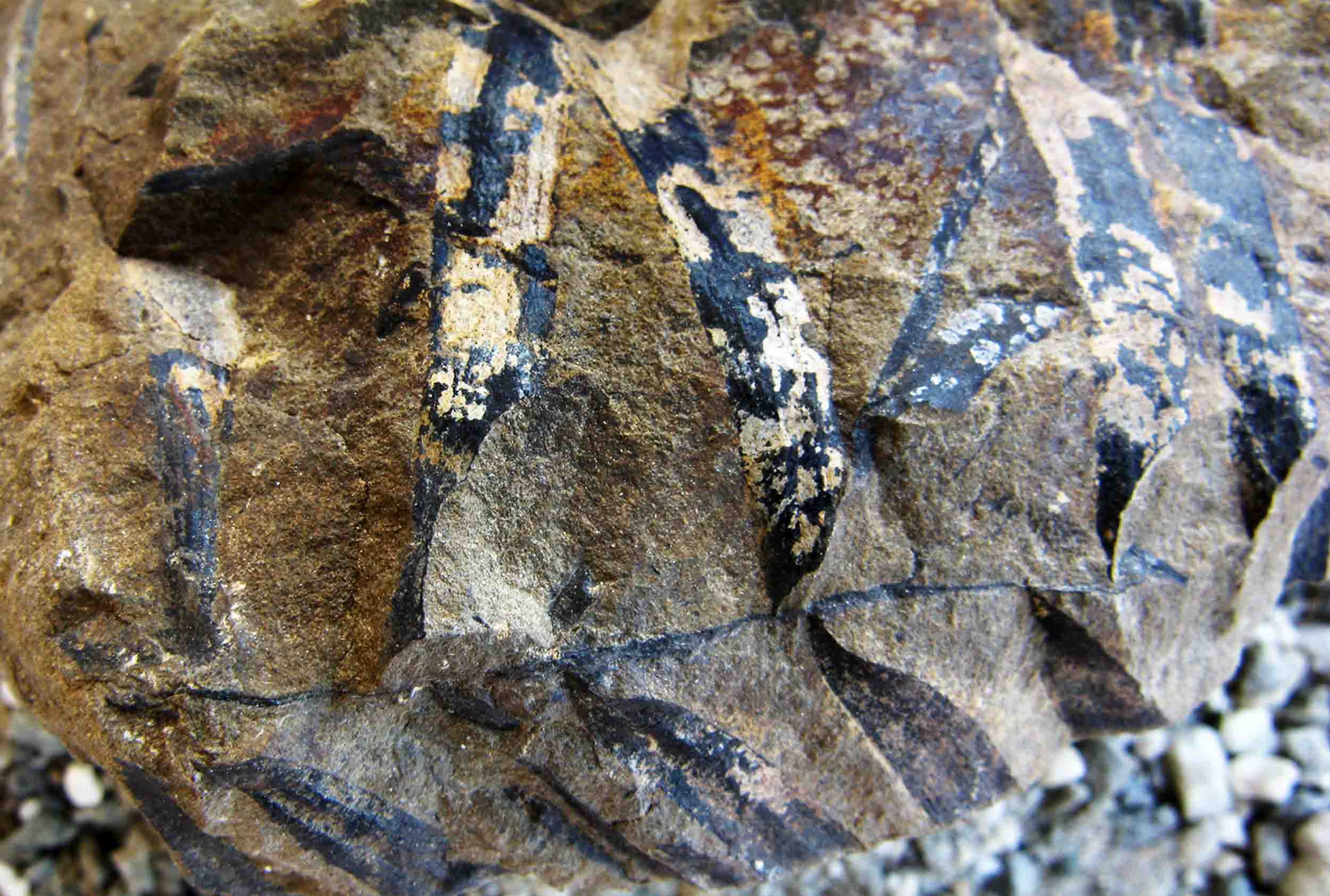
The Jurassic fossil forests at Curio Bay, southern New Zealand, have been known for at least a hundred and fifty years. They first appear to have come under scientific scrutiny in 1878, when the geologist James Hector collected there. He was followed by another geologist, Hector in 1878, and then James Park, who visited in 1886, and paleontologists Louis Crié worked on material from nearby in 1889. Then in the early 1900s, two Scotsmen, Dr Robert Kidston and Professor David Gwynne-Vaughan began what was to become a famous, productive (and apparently pipe-smoking partnership: Liston and Sanders, 2005). Kidston was sent a piece of petrified tree fern trunk from the Curio Bay area. That little fossil fragment from southernmost New Zealand was the spark that resulted in what Liston and Sanders (2005) called “a pivotal event in the development of Paleobotany” – a series of beautifully illustrated publications on the fossil Osmundaceae (Kidston and Gwynne-Vaughan, 1907, 1908, 1909, 1910, 1914). Within these tomes, two new species of a genus ‘Osmundites’ – specifically for fossil fern trunks, were described from the Curio Bay area.
But then Curio Bay came to the attention of Edward Alexander Newell Arber. He was a palaeobotanist who worked at the Sedgewick and British Museums, from 1899 until his untimely death in 1918 – aged just 47. But in 1909 he married “Miss Agnes Robertson, D.Sc., F.L.S., herself a distinguished botanist” (D.H.S., 1918), and they had a daughter, Muriel, in 1913.
By 1916, Edward Arber had at least 62 publications to his name (a few were co-authored), had clearly achieved a global reputation. Around this time, he must have developed a special interest in New Zealand’s Mesozoic plant fossils. Arber was able to access existing New Zealand plant fossil collections in the Sedgwick Museum, Cambridge, and the British Museum (Natural History), and although he never traveled to New Zealand, he was obviously well-enough regarded to have some more New Zealand material sent directly to him.
Some of this was loaned by the Geological Survey of New Zealand – that also gave him a grant towards the cost of the illustrations in the planned publication. Several individuals contributed in various ways. J.A. Thomson, F.G.S. (formerly Palaeontologist to the Survey), provided information about the plant localities and some of the New Zealand literature about them. D.G. Lillie, M.A., of St. John’s College, Cambridge, was thanked “especially for notes on the fossil forest of Waikawa”, and New Zealand’s famous botanist, Dr. L. Cockayne, F.R.S., sent him “photographs of the fossil forest at Waikawa” (‘Waikawa’, was also used for Curio Bay). Arber also acknowledged loans of some private collections from New Zealand, including from Mokoia Farm, near Gore.
Arber managed to put all this together – and delivered. The results were published as a New Zealand Geological Survey Memoir in 1917 – 80 pages of text plus 14 plates. He named one new species – Podozamites gracilis, a conifer. His memoir remains the largest published work on New Zealand’s plant macrofossils. It features plant fossils from several localities across New Zealand, inclusing Curio Bay, which Arber called “the most remarkable of all” Mesozoic fossil forests. Arber listed ten types of fossil foliage from Curio Bay, ranging from fern, or fern-like plants, to cycads and conifers.
And then a year later – he died (I hope the effort didn’t kill him!). For the last word on Edward Arber. I think this, in one of his letters (quoted by one of his obituary writers (A.A., 1918), is appropriate:
“My mania is quite a modest one. It is a desire to visit every spot in this country where fossil plants have ever been found. To gain that full power of knowledge which can only be got by having been to the place, seen it, photographed it and collected from it. When you have done this you have a ‘ grip ‘ which is masterly.”
In 1934, another English scientist, Dr Wilfred Edwards, a paleobotanist at the British Museum (Natural History) had a new look at New Zealand’s Jurassic plant fossils. Edwards upped the total number of species to 16. The new species included a horse-tail, and, an araucarian cone-scale, and he confirmed that two types of fossil wood were present. But Edward Arber’s work remained the key contribution in the field.
His death left Agnes to look after a five year old girl – and continue her own research. She was phenomenal. In the words of Schmid (2001): by age 48, Agnes Arber had already produced “three books, 118 publications (59 papers, 29 notes, nine obituaries, three obituary bibliographies, four book reviews, two letters, ten poems and two abstracts), and one edited book and four edited papers for her husband”. She became “the first woman botanist (and the third woman ever) to be elected to the Royal Society and the first woman Gold Medalist of the Linnean Society”.
In the 1980s, the New Zealand botanist Michael Heads introduced me to, perhaps her most intriguing book, ‘The Natural Philosophy of Plant Form’. The title alone should give some idea of the intellect behind it. The book, and the mind behind it, was clearly extraordinary, and made a deep impact on me – though I couldn’t explain to you now, and certainly not then, what exactly made it so. But I can point you towards several other researchers, who have analysed Agnes Arber’s contribution: Classen-Bockhoff (2001), Schmid (2001), and Straetmanns (2024).
Agnes lived another fifty-one years after the death of her husband. Perhaps the last words about Agnes Arber should come from one more of those experts: Vittoria Feola (2019):
“One may disagree with her that plants connect the macrocosm to the microcosm, but one should be in awe of her ability to connect the beauty of Wordsworth’s poetry, to Plato’s philosophy, to complex notions of plant morphology”.
What would have happened if Edward had not died so young? Would Agnes have have still risen to the intellectual heights that she did? Would Edward have developed a philosophical bent as well? It was certainly a loss to palaeobotany.
Maybe Edward, and perhaps Agnes too, would have made it to the fossil forests at Curio Bay, in the far south of New Zealand.
References
A.A. 1918. Obituary. E.A. Newell Arber, M.A., Sc.D., F.G.S., F.L.S. Geological Magazine, 5: 426-431.
Arber, E.A.N. 1917. The Earlier Mesozoic Floras of New Zealand. New Zealand Geological Survey Bulletin, 6: 1-80.
Arber, A. 1950 The Natural Philosophy of Plant Form. Cambridge University Press.
Classen-Bockhoff, R. 2001. Plant Morphology: The Historic Concepts of Wilhelm Troll, Walter Zimmermann and Agnes Arber. Annals of Botany, 88: 1153-1172. doi: 0.1006/anbo.2001.1544
D.H.S. 1918. Edward Alexander Newell Arber (Obituary). Annals of Botany, 32: 7-9.
Feola, V. 2019. Agnes Arber, historian of botany and Darwinian sceptic. Essay review. British Journal for the History of Science, 52: 515–523.
Kidston, R.W. and Gwynne-Vaughan, D.T. 1907. On the Fossil Osmundaceae. Part I. Transactions of the Royal Society of Edinburgh, 45: 759-780.
Kidston, R.W. and Gwynne-Vaughan, D.T. 1908. On the Fossil Osmundaceae. Part II. Transactions of the Royal Society of Edinburgh, 46: 213-232.
Kidston, R.W. and Gwynne-Vaughan, D.T. 1909. On the Fossil Osmundaceae. Part III. Transactions of the Royal Society of Edinburgh, 46: 651-667.
Kidston, R.W. and Gwynne-Vaughan, D.T. 1910. On the Fossil Osmundaceae. Part IV. Transactions of the Royal Society of Edinburgh, 47: 455-477.
Kidston, R.W. and Gwynne-Vaughan, D.T 1914. On the Fossil Osmundaceae. Part V. Transactions of the Royal Society of Edinburgh, 1: 469-480.
Liston, J.J. and Sanders, H.L. 2005. The ‘other’ Glasgow Boys: the rise and fall of a school of palaeobotany. Pp 197-227. In: Bowden, A.J., Burek, C.V., and Wilding, R. (eds). History of Palaeobotany: Selected Essays. Geological Society, London, Special Publications, 241.
Schmid, R. 2001. Agnes Arber, née Robertson (1879-1960): Fragments of her Life, including her place in Biology and in Women’s Studies. Annals of Botany, 88: 1105-1128.
Straetmanns, V.M. 2024. The Lady and the Plants: Two notions of teleology in Agnes Arber’s Philosophy of Plants. Journal Historical Biollogy, 57:533-555. doi: 10.1007/s10739-024-09793-5