The ‘God’ of trace fossils, Adolf ‘Dolf’ Seilacher, once visited our Geology Department, when I was an undergrad. My Prof, Doug Campbell, arranged a field trip for him, and invited me to come. We went to the Oamaru area, and quite incidentally, we took Seilacher to see some of the well-known early Polynesian rock art on the limestone. He dismissed them with a snort. On the other hand, his knowledge about bioturbation and trace fossils was daunting.
Bioturbation’ simply means ‘the reworking of soils and sediments by animals or plants’. When these activities are found in the geological record, they can be called ‘trace fossils’, in contrast to body fossils – remains of the actual orgaims that made the traces. A fancier term is ‘Ichnofossil’. The three terms are roughly interchangeable.
Long before I met him, Seilacher (1967) had become famous by going a step further, by proposing the concept of ‘ichnofacies’. These are groups of trace fossils which keep recurring in particular combinations of environmental conditions (e.g. salinity, water energy, substrate type, and oxygen levels). Sometime around that meeting, I had found a simple trace fossil at Curio Bay. It came from the cliff just below what is now the lookout platform above the main fossil forest, and appeared to have been a simple ‘burrow’, a few millimeters in diameter, where ‘something’ had gone from one layer into another. I photographed it, and this became a figure in my 1982 ‘Third Year Project’ on Curio Bay’s Jurassic fossil forests. But at the time, the ‘burrow’ was only a curiosity. I had no particular interest in it beyond that.
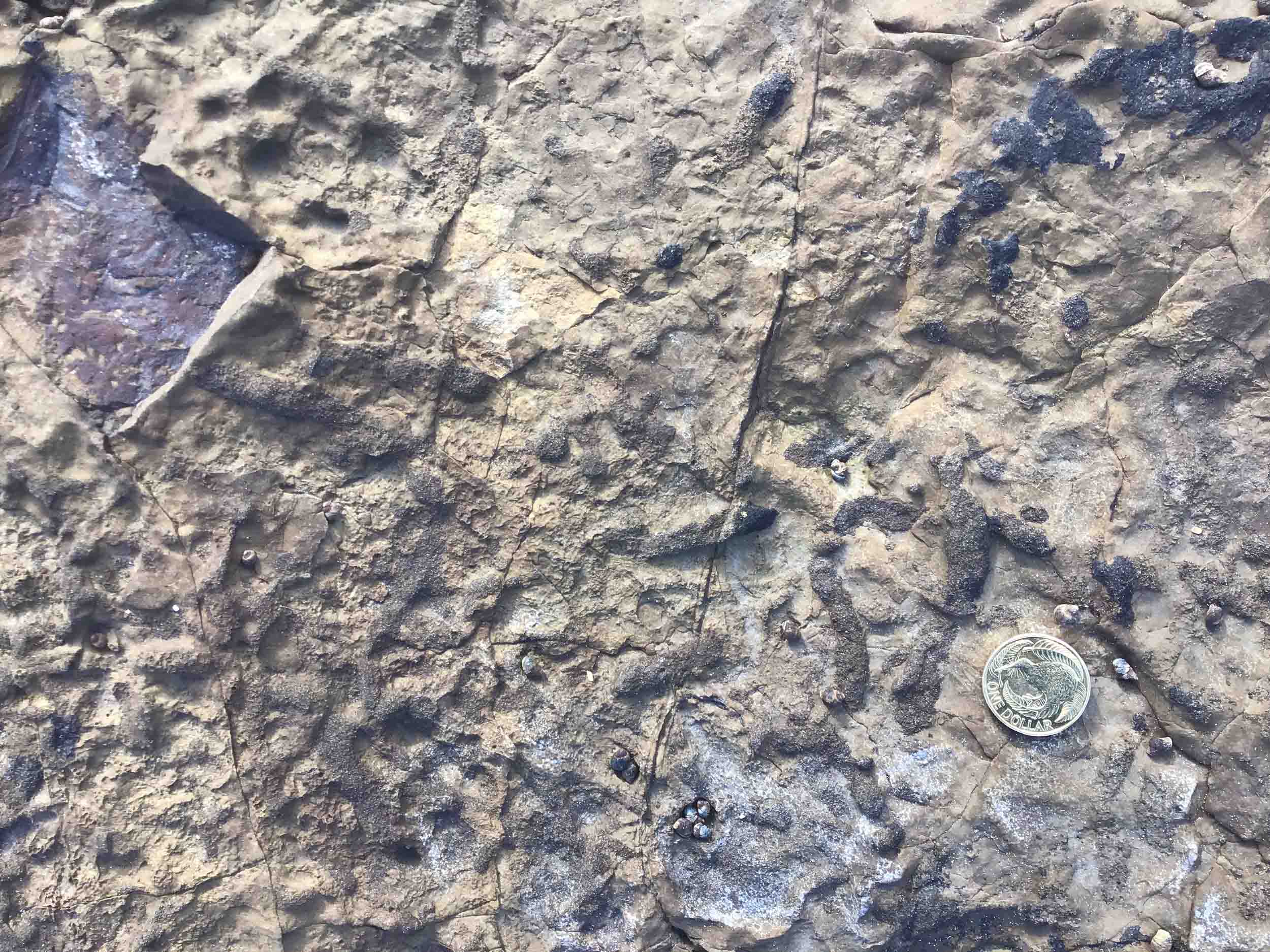
Some years after that (the 1990s), I struck ‘bioturbation mother-load’: closer to the headland, in from of the campground, there were two layers of dense bioturbation (see the Featured Image). These were indicated on my measured section of Curio Bay (Pole, 2001). Now I was super-excited. But what exactly are they?
Bioturbation is a catch-all phrase that covers traces with all sorts of origins. The phenomemon can be found in almost any type of sedimentary environment, from marine to fresh water- though as a sedimentary phenomenon, it’s probably been most thoroughly documented in marine settings. Once, I was describing the rocks at Curio Bay to a very experienced sedimentologist. I was making the case for them being entirely fluvial, rather than at least partially marine. When I happened to mention ‘bioturbation’, he bit his lip and looked me straight in the eye! It was disconcerting – nevertheless, I think Curio Bay was a fair way from the coast in Jurassic times, and I have never seen any clear indications of marine there (for instance tidal structures). In the very year that discussion took place, a section on the ‘Ichnology of fluvial systems’ was published as part of a textbook on trace fossils (Miller, 2007). In fact, a fluvial environment example of trace fossils had, long before, been published from New Zealand (Fordyce, 1980).
The study of fossil bioturbation/trace fossils has now become so detailed, that many different types of ‘trail’ or ‘burrow’, etc, can be recognised, and have been given Latin names, just like species of ‘body’ fossil (e.g. Häntzschel, 1975, any many since). At Curio Bay, one ‘type’ of bioturbation predominates – simple trails, or ‘burrows’, roughly 5 mm in diameter, visible where the lower, darker, coarser sandstone, has been brought up, into the lighter, overlying finer sandstone/silt. They extend over horizontal bedding surfaces, apparently random squiggles, just a few centimeters long. There might be some cases of branching, but maybe these are just the intersections of two simple burrows. There is no clear internal structure to them.
In some cases, they extend vertically as well. In the science of bioturbation (‘ichnology’), this is something very important – because a vertical trail is a record of completely different behaviour to horizontal trails. There are also some rarer larger horizontal ‘burrows’, more like 15-20 mm across, presumably formed by something quite different.

The large trace fossil type in the Jurassic at Curio Bay. Photo: the author (Mike Pole).
One curious thing is apparent – the bioturbated layers at Curio Bay are associated with a feature called ‘honeycomb’ weathering. This is a phenomenon that can often form in rocks on the coast, where they are repeatedly covered with salty water and sun. They are not fossils, as they are forming today – but the individual fossil burrows can act as a ‘trigger’, like a kind of weak-spot, for the honey combs to develop. At Curio Bay, bioturbation, and the honeycomb weathering, is extensive on two platforms, both at the western end of the bay, opposite the campground. They are separated by a low cliff, and the upper bioturbated layer, the bioturbation grades confusingly into honeycomb structures.

Left: ‘Honeycomb’ weathering, superimposed on bioturbation. Right: Vertical bioturbation (dark sand, projecting up into yelowish silt), with some honeycomb weathering. Both in Jurassic of Curio Bay. Photo: the author (Mike Pole).
However, to my untrained eye, the Curio Bay fossil burrows don’t have any special features that could identify them with either a distinct ‘named’ type of trail, or to any particular type of organism. They may have been made by ‘worms’, some sort of crustacean, or something else. What exactly they were formed by remains a question for further research.
But why are they only found in a very few layers at Curio Bay? As Seilacher had argued, bioturbation types can reflect a combination of specific conditions. The fossil burrows were likely formed on the bottom (or just below it) of a small body of freshwater, like a floodbasin lake, by some sort of ‘bottom-dwelling’ organism. Briefly, the right combination of factors may have come together – perhaps shallow standing water and then a light fall of volcanic ash – that allowed a modest feeding frenzy over the lake bottom. Before the sediment surface was completely burrowed, it may have been buried by another later of sediment, and as the organisms fought their way back to the surface – the vertical trails were formed.
I wish I could now show Seilacher what’s at Curio Bay – he would certainly see all sorts of details in those fossil trails that I don’t. Unfortunately, he passed in 2014. But I remain super-excited about these things. They are a sign of animal life (‘animal’ in the very broadest sense). Not quite in the league of dinosaur footprints, but work with me on this!
References
Fordyce, R.W. 1980. Trace fossils from Ohika Formation (Pororari Group, Lower Cretaceous), lower Buller Gorge, Buller, New Zealand. Journal of Geology and Geophysics, 23: 121–124.
Häntzschel, W. 1975. Part W, Miscellanea. Supplement 1, Trace fossils and problematica. In Treatise on invertebrate paleontology. Boulder. Geological Society of America.
Pole, M.S. 2001. Repeated flood events and fossil forests at Curio Bay (Middle Jurassic), New Zealand. Sedimentary Geology, 144: 223-242.
Seilacher, A. 1967. Bathymetry of trace fossils. Marine Geology, 5: 413–428.