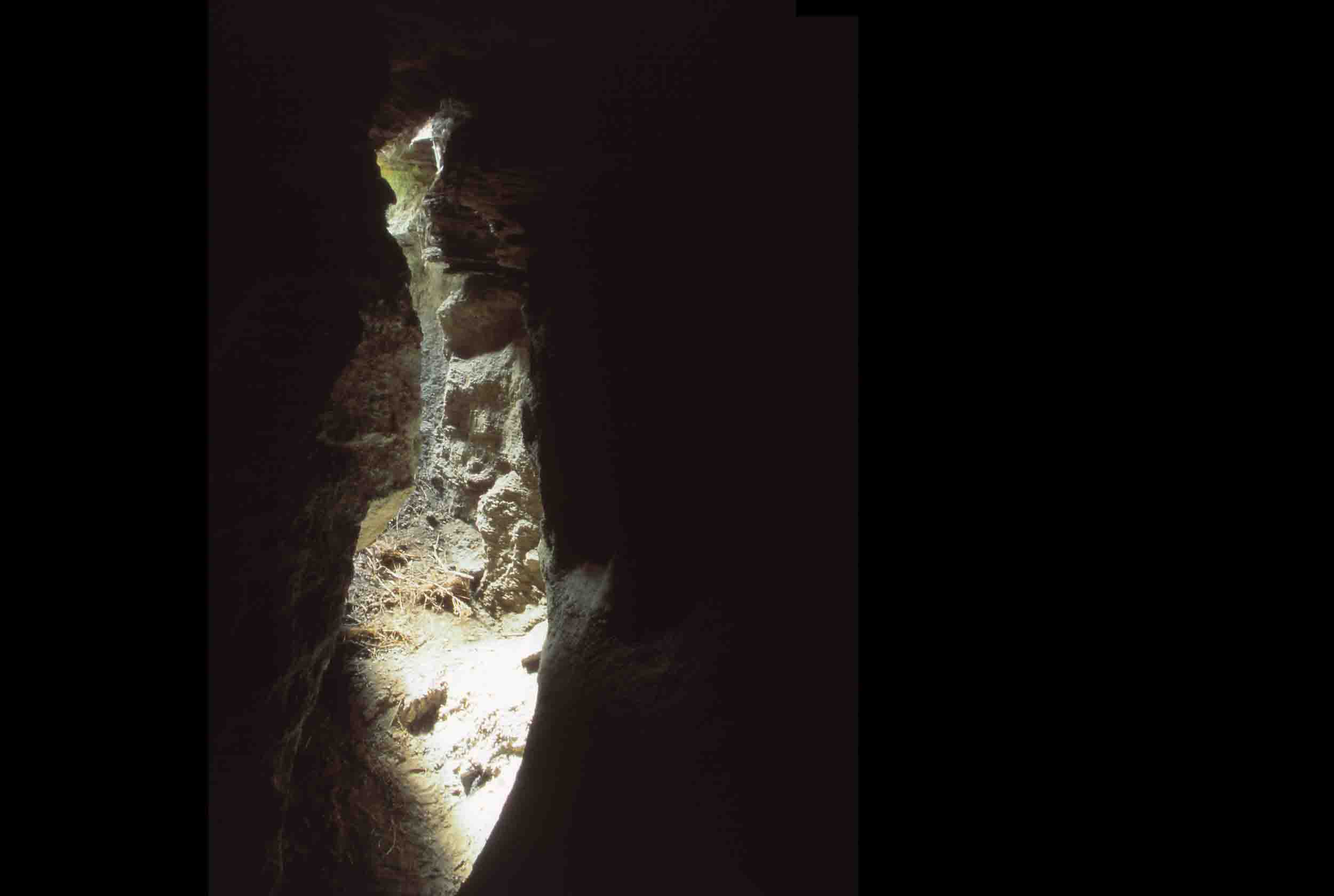
“We found our further course in this direction stopped by a wide and deep gully, the edge of which bristled with huge castellated-looking dark rocks”.
Oh boy, did those words, written more than a century before, fire me up. They were written by ‘the Hon. Captain Fraser, F.R.G.S.’ in his 1873 description of ‘the Earnscleugh Moa Cave.’ The cave lies above Alexandra, on the flanks of the Old Main Range – a mountain that, until I went to University, was rarely out of my sight. As a school-boy, I’d heard of it, but knew of it only as a mystery – a ‘lost cave’, but located somewhere in the schist-tor country of Earnscleugh Station, in New Zealand’s Central Otago – a dry and, currently, remarkably barren region.
The first official account of the Earnscleugh Cave was made in a paper by James Hector in 1871, where he quoted a description of the site by Dr Thompson (of Clyde). It had been discovered by a boy, who was on his way to his father’s gold claim.
It was then reported by the Honourable Captain Fraser in 1873. Before Fraser could get to it, Mr Arthur and Dr. Thomson, of Clyde, had made a “razzia” on the cave, and, to Fraser’s obvious disappointment, had “carried away a very large collection of the best preserved Moa bones I have ever seen”.
Fraser’s account of getting to the cave, reads like something out of a description to find buried pirates treasure:
“[We] entered by a narrow gorge the once beautiful valléy of the Conroy, now a hideous chaotic mass of alluvial workings” from which “vast quantities of Moa bones” had been uncovered.
“We passed Pipeclay Gully, in which was found the lower jaw of a Saurian in a perfect state of preservation.”
“About four miles from the gorge we turned suddenly to the right, and crossing the Conroy we commenced a gradual but oblique ascent of a spur of the Umbrellas. After attaining a height of about 800 feet above the Conroy we found our further course in this direction stopped by a wide and deep gully, the edge of which bristled with huge castellated-looking dark rocks”.
They soon found the cave – it lies in a landscape of schist rock, which have eroded into ‘tors’ (the castellated-looking rocks). These are a distinctive part of the Central Otago landscape. Many years later (1965) J.D. McCraw (his figure 3) would draw a “Diagrammatic perspective sketch of a Central Otago block mountain, based on the Od Man Range, looking westward”. It’s basically exactly the area where the cave is.
Back in 1873, Fraser and companions further explored the cave system, discovering passages such that “there was always a current of dry air” passing through – probably a key reason for the mummified preservation of the ancient remains. Despite the earlier ‘razzia’ they still found bones, feathers, skin, and eggshell of extinct New Zealand birds scattered everywhere. But what was of particular interest to me, was several references Fraser made to finding totara wood:
“I remarked several pieces of totara in the cave, which would lead one to suppose that the totara tree grew on the platform, before the original mouth of the cave was closed by the rock which forms the roof of the present landing place.”
And in what seems to have been another entrance to the cave:
“We found a sound stick of totara in this cave, which is at least forty feet below the level of the platform. Above the ventilator, and on an inaccessible ledge of the rock, we saw a large piece of totara which had been left there since the parent tree had crashed in its fall against the face of the rock.”
There are no totaras in the area today (a now dead individual in the garden of Mitchells Cottage might be an ‘original’ tree), but they are generally accepted as being present at highish altitudes in pre-human times. Their presence basically indicates forest in an area which is now treeless.
Two years later (1874), Captain Hutton and Professor Coughtrey published more on the Earnscleugh Cave. Mostly details on the species discovered.
And then, for the next century or so, the Earnscleugh Cave essentially disappeared. At least from the academic world. As a local schoolboy, from the late 1970s, then through the mid 1980s as a university student, I made several (unsuccessful) trips to the Conroys region, looking for the ‘lost’ Earnscleugh Cave. Those words of Fraser’s, that the area “bristled with huge castellated-looking dark rocks” had stuck in my mind!
The owner of Earnscleugh Station, Mr Mulvena, was quite happy for me to wander around, but he was rather tight-lipped about where the cave actually was. He did let me know he’d first spotted the cave when he had watched a sheep take shelter in it during a snow storm.
A local rabbit hunter, who knew of my interest, let me know of another ‘cave’ in the Aldinga region of the Conroys (lower than where the Earnscleugh Cave was). This would have been 1977-1978. I found that one, and it seemed like a similar ‘system’ to what Fraser had described – whereby huge schist blocks have moved, and opened up fissures behind them. But the Aldinga also has some of the typical, rock overhang shelters, utilised by moa.
Here’s a couple of diary entries from early student days:
12.11.83. Mum and I went to Conroys Dam in search of the Earnscleugh Cave. I walked on ahead, but reasonably high up in the headwaters, found moa bones but no cave.
16.01.84. Looking for Earnscleugh Cave for the third time. Turned right at Wigwam Rock [one of my landmarks] and made a big circle up in headwaters – nothing. Poked around Wigwam Rock, still nothing.
The Earnscleugh Cave was ‘officially’ rediscovered in 1993, and announced in a report by Peter Bristow (Dept of Anthropology, Otago University), with special thanks to the landowner, Allistair Campbell, for its relocation.
A serious excavation was carried out in 1994, by Geoffrey Clark (Australian National University), Peter Petchey and Peter Bristow (Anthropology Department, University of Otago), and Matt McGlone (Landcare Research) and published as Clark et al. (1996). The study covered bones, palynology, and included radiocarbon dates. The oldest of these, from “a complete moa tarsometatarsus found 2 m below the top of the upper-slope face”, was about 2176 years before the present. Thus the known record in the cave extend to pre-human (and thus pre-serious fire) times.
The bone material they found (among others) included moa, the extinct goose (Cnemiornis calcitrans), the extinct Finsch’s duck (Euryanas finschi), the mountain parrot kea, rifleman, robin, tuatara, and greater short-tailed bat. The palynology samples contained abundant shrubs, but the amount of podocarp pollen (likely indicating genuine forest) was substantial. Matai pollen reached 20% in some samples.
Clark et al. (1994) drew intriguing results from their study: there was an “intricate and diverse mixture of scrub, open woodland and forest” and “a complex mix of shrubland-forest communities once existed around the cave”. Their “most likely explanation” for the high amounts of podocarp pollen “is that small stands of matai, totara, kahikatea and probably even rimu grew in the more sheltered and damper environments of the valley sides in this region. Tree ferns may also have been present, although this is less certain”.
Elsewhere they wrote:
“small stands of tall podocarp forest and open woodland of kowhai, ribbonwood and probably kanuka (Kunzea ericoides). South-facing slopes appear to be the most likely location for forest (Molloy et al. 1963). At higher altitudes (above 700 m) and with increasing rainfall, the dense lowland scrub would have been progressively replaced by mountain totara, Phyllocladus and silver beech, the last two forming a continuous upper tree line.”
That’s pretty amazing stuff for a now virtually treeless landscape.
Of particular interest to me, Clark et al’s (1994) results showed that podocarp pollen declined, and kowhai pollen appeared, although only in small amounts – around 5% or less. But the dominant pollen was now shrubs or vines, such as Muehlenbekia and Coprosma. I suspect that the small amounts of kowhai pollen, may be masking a much larger presence in the landscape. Kowhai doesn’t produce much pollen, so the output tends to get swamped by those species that do.
In 1998 Trevor Worthy reviewed Otago’s Quaternary record of vertebrates, Earnscleugh Cave material included. He confirmed the presence of tuatara and the Otago Skink, the Greater Short-tailed Bat, two species of moa – Dinornis struthoides and Dinornis giganteus, as well as the South Island Extinct Goose, Finsch’s Duck, Weka, Hodgens’ Rail, South Island Takahe, Laughing Owl, the Owlet-nightjar, Rifleman, New Zealand Pipit, New Zealand Robin, South Island Kokako, and even the Little Spotted Kiwi. A kiwi certainly implies soils remarkably different from the the rocky surface of the ‘Swemiarid’ soils of today. I presume that if a soil scientist time-teleported themselves back just a thousand years or so, they would map them as something else.
Another addition to Earnscleugh Cave knowledge came in 2008, when Jamie Wood and Susan Walker reported finding seeds of a variety of shrubs, lianes and herbs, such as Coprosma sp. cf. propinqua, C. sarmentosa, and Myrsine sp. cf. divaricata, along with spines of Discaria toumatou. These live in the area today, but most interesting of all – they found seeds of Pseudopanax ferox (lancewood). There are no lancewoods within a long range of Earnscleugh Cave today, and it’s probably fair to say, it’s a genuine ‘bush’ plant (‘bush’ being true forest in New Zealand-talk).
The Earnscleugh Cave – now public conservation land, is a truly remarkable site. Not only because of its biodiverse assemblage of vertebrates, and dated palynology record, but also from its location – a hundred meters higher altitude than the 200-400 m asl of numerous ‘overhang’ shelters, and also because it’s not an overhang, but a crevase. In that sense, it helps ‘fill in’ a gap.
Earnscleugh Cave is situated above, but in the same catchment as the amazing Mokomoko Dryland Sanctuary. This is where a 1.6 km predator-proof fence has been built to enclose 14 hectares of dryland habitat. It now includes at least seven species of skinks and geckos. The Earnscleugh Cave is, of course, somehow relevant to Mokomoko – although ‘rewilding’ is not the goal of Mokomoko, it’s protecting reptiles. Given the one-time presence of tuatara in the area, it might seem like a good idea to reintroduce some there. However, there are no tuatara in Mokomoko – and for good reason. Having one in that confined space would be rather detrimental to the skinks and geckos! (they would get eaten in short order).
It’s not that tuatara (and other predators, like weka) couldn’t coexist with Mokomoko’s various reptiles, but in a very small area, it would be a literal, very uneven cage-fight. To be sustainable, and to really try rewilding, with the various creatures that have been found in Earnscleugh Cave (bats, kiwis, weka, maybe even the South Island kokako), you’d need a much larger area for it to be sustainable.
And me? With a bit of help from a local, I finally got to visit Earnscleugh Cave in February, 1999 – more than twenty years after I started looking. Fraser’s description of the surrounds was pretty good. Even his altitude was spot-on. Fraser said they were 800 feet (243 m) above the Conroy. Conroys Dam is 905 feet altitude (276 m) and the cave is at 1771 feet (540 m). So I dunno why I kept focusing further down in the Conroys.
But indeed, it was bristling with huge castellated-looking dark rocks….
References
Bristow, P. 1993. The rediscovery of Earnscleugh Cave. Archaeology in New Zealand, 36: 205-210.
Clark, G.R., Petchey, P., McGlone, M.S., and Bristow, P. 1996. Faunal and floral remains from Earnscleugh Cave, Central Otago, New Zealand. Journal of the Royal Society of New Zealand, 26(3), 363-380.
Cockburn-Hood, T. H. 1874: Notes respecting the moa cave at Earnscleugh, Otago. Transactions and proceedings of the New Zealand Institute 6: 387—388.
Fraser, T. 1873: A description of the Earnsclough (sic) moa cave. Transactions and proceedings of the New Zealand Institute 5: 102-105.
Hector, J. 1871. On recent moa Remains in New Zealand. Transactions and proceedings of the New Zealand Institute 4: 110—120.
Hutton, F. W.; and Coughtrey, M. 1875: Notice of the Earnscleugh Cave. With remarks on some of the more remarkable moa remains found in it. Transactions and proceedings of the New Zealand Institute 7: 138-144
McCraw, J.D. 1965. Landscapes of Central Otago. Chapter 2 (pp. 30-35) in ‘Central Otago: A Symposium to mark the centenary of the ‘Golden Decade’ of the 1860s in Central Otago’. Lister, R.G. and Hargreaves, R.P. (eds). N.Z. Geographical Society (Caxton Press, Christchurch.