In my Fifth Form year at Dunstan High School, Alexandra, my Biology Teacher was Peter Child. He retired shortly afterwards, and as his Obituary puts it (Pierce, 1986), this was a ‘liberation’! Yes, I was one of the local yokels in a small country town, a posting that must have severely tried the sanity of an academically-minded man. As his Obituary also says, Child made 35 contributions to the ornithological journal, Notornis, and accumulated a collection of over 3,000 lichen specimens.
One day, well-aware of my interest in prehistory, he told me about totara trees growing up in the headwaters of the Waikerikeri Valley – literally within walking distance of my home. Hearing that ‘native bush’ trees grew this close was astonishing to me. Alexandra is the core of Central Otago, and the most arid part of New Zealand. The dry summers and harsh winters, as well as gold miners and plague-proportion rabbits, all contributed to it being an essentially, barren, treeless area when Europeans began to move in, in the late 1850s. Just up the Clutha River from Alexandra, are the smaller places of Cromwell and Bannockburn. James Parcell called his 1951 history of those villages ‘Heart of the Desert’. It was a totally apt description, and ‘desert’ was pretty much what I could see out the window of my class at Dunstan High.
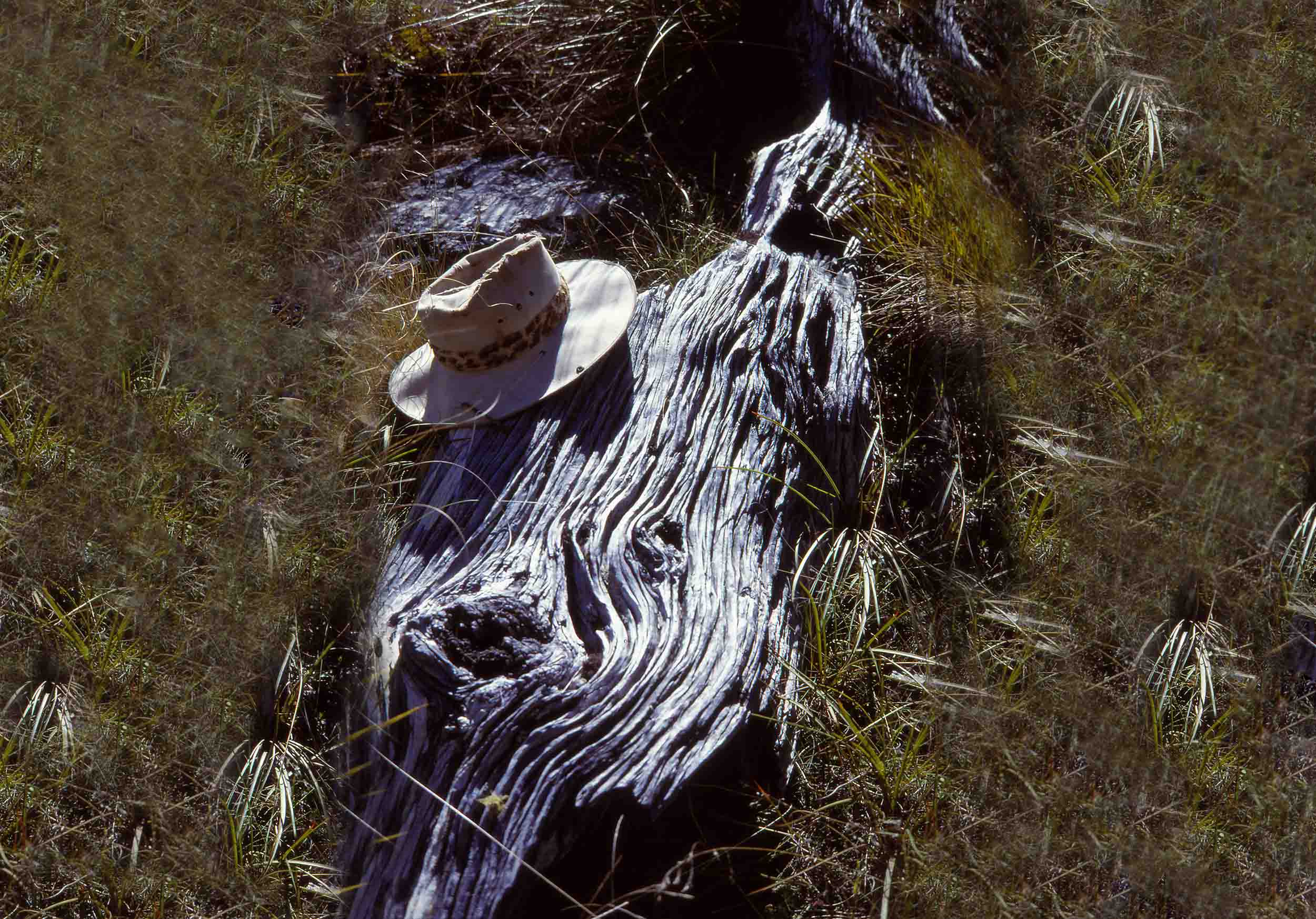
So I duly made my way up the Lilico Spur, the eastern flank of the Waikerikeri Stream – to the steepest spot of the local topographic map, and was stunned by what I saw – hundreds of living totara (including Podocarpus laetus – earlier known as P. hallii), some Dracophyllum, and broadleaf, and even a lancewood. The totara were clearly ancient, gnarled and stunted, but multi-stemmed – rather like enormous pot-plants. They were growing as individuals, not closely-packed and not forming any kind of forest canopy. But as I gingerly picked my way down the western slope, far way on the other side of the gorge – I could see a few bleached logs, lying among the tussock. I made my way up to one – and it was clearly unlike the living totara nearby. This had been a tall tree – with a straight trunk (see the Featured Image). And there, all in a day, I was introduced to the basic ‘mystery’ of Central Otago’s ‘lost’ totara forests.
The phenomenon was by this point, well-known. In a landmark 1963 paper, a group of New Zealand botanists (Molloy et al, 1963) synthesised the distribution of what they called ‘subfossil forest remains’ over the eastern South Island. They built on some earlier academic publications (e.g. Holloway, 1954; Cox et al., 1960; Cumberland, 1962), and collated the locations of old logs, charcoals, special soil types, wind-throw ‘dimples’, and various historical accounts.
They confirmed that most of the surface logs were Podocarpus hallii, but at lower altitudes, P. totara was also involved. Most of the charcoal was also podocarp, but occasionally was Nothofagus, and other dicotyledons. Their map made it clear just how widespread this vanished forest had been. Just in the Central Otago region, podocarp wood and or charcoal, was located on the slopes of the Old Man and Nobby Ranges, above Roxburgh, near Paerau, on the slopes of the Rock and Pillar Range, the Manorburn Reservoir, near Oturehua, and along the slopes above the Nevis River. Evidence of Nothofagus, in the form of charcoal and podzols, was found a little to the north of Oturehua and St Bathans.
It seemed fairly clear what had happened to the forests – they were burnt, but wind-throw seems to have also been in the mix. But the bigger mystery may be their existence in the dry interior, and exactly what they looked like.
The next contribution was by Juliet Burrell (1965) in the Otago University’s Botany Department. Her focus was on the ecology of Leptospermum (Manuka and Kanuka) patches in Otago, but she placed them into an ecological context with living totara. She proposed that in pre-human times, Leptospermum shrubland typically occupied lower and drier mountain slopes. As moisture increased, either upslope, or in different situations, this shrubland could give way to a totara (Podocarpus hallii) ‘woodland’ on south-facing slopes, or Nothofagus forest on north-facing slopes.
Then, in 1972, Judith Wells, another Otago University, Botany Department student, published specifically on the ecology of Podocarpus hallii in Central Otago. She drew attention to the “long, straight nature” of some of the old logs, and in contrast to Burrell, concluded that the “distribution of both logs and living trees is unrelated to aspect”. Wells then went on to make two critical points. Firstly, she noted that:
“There is an important difference in growth form between the living trees and that suggested by the log remains. The former are bushy and multi-leadered …, a form typical of open-grown trees, while the logs are long, straight, and unbranched (Fig. 11), a form typical of trees grown within a forest.”
Then surmising:
“If the pre-European vegetation had a density as low as that implied by the maximum density of logs, their growth habit predictably would have been multi-leadered like those surviving on the Range today. Since this is not the case, it seems logical to assume a much higher density of trees.”
and therefore:
“in order to produce the long straight logs there must have been another important component with less durable wood than totara, in the pre-European forest.”
So the straight trunks of many of the logs is a sign of trees growing up with limited access to light – in a forest canopy. The one-time existence of totara on now treeless mountains was one thing, that they were components of an actual forest, was quite another.
The phenomenon of ‘subfossil’ logs was very usefully summarised by archaeologist Atholl Anderson (1982) in a paper on Central Otago moa habitat. He added more historical accounts of logs to those cited by Molloy et al. (1963). Past and present vegetation of the Upper Clutha area – on the periphery of Central Otago, was documented by Wardle (2001a, b). Log (and charcoal) distribution of Central Otago was then summarised by Walker et al. (2003, 2004), who also modeled “diverse forests, principally of Podocarpus nivalis, P. hallii, Nothofagus menziesii, and N. solandri var. cliffortioides” (their Zone VII) on “large areas of the elevated crests of Rough Ridge and the Lammerlaw Range and mid-elevation zones on the flanks of most ranges.”
It’s now clear that most of these forests were destroyed by fire, soon after humans arrived in New Zealand (e.g. Perry et al., 2012). In some isolated, fire-protected areas, a few of the key species hang-on, but now as a ‘woodland’ – the forests have been ‘lost’.
Thanks to our national gem – ‘Papers Past’, I’ve dug up a few more references to totara logs, that are perhaps less well-known:
1. ‘Lake County’ (Otago Witness, July 21, 1898, p. 25)
“…for it must be called to memory that many of the hills of the Wakatipu and Wanaka watersheds were covered with dead and charred totara logs, which it would puzzle a Philadelphia lawyer to say how old they were.”
2. ‘The moa’ (Otago Witness, April 6, 1904, p. 73) – referring to the Waitahuna area
“On the same ridge, and adjacent to the bones, there were a large number of old totara logs from. 10ft to 12ft long, and many more of the totara logs were to be found in the narrow gorges in the creek below.”
3. (The Oamaru Mail, May 16, 1907) – referring to the Kurow area
“On all the high country of the district charred totara logs are scattered about, and are used by settlers for fencing, so that it is clear that, at one time the whole of an area which is now considered by the Forestry Department unsuitable’ for the growth of trees was clothed with a thick growth of totara.”
4. No. 5. Early Strath-Taieri (J.J. Ramsay: Otago Witness, September 19, 1908, p. 80)
“Totara logs were also got in many of the gullies, and in some of the swamps which were drained when settlement set in great quantities of wood known as “bog wood” were obtained”
5. The Hardy Pioneer. Story of John Hunt (Otago Witness, May 27, 1930, p.5)
“On the downs behind the Papakaio Station he noticed a number of totara logs, showing that the country had been bushed once. In the wash gravel at Weatherstones he came across a broadleaf tree, giving evidence that the bare hills in that vicinity had once been forested.”
6. No. 2 The Early Days of Hyde (Otago Witness, August 29, 1906, p. 13)
“On the sides of the Rock and Pillar, however, the diggers found huge charred totara logs in large quantities, and these logs they carried home on Saturdays— that is, those who were married and whose wives wished for a substantial fuel. Needless to say, the totara logs made an excellent fire. In” this connection I may mention that over the whole of the Rock and Pillar, and, I understand, on other Central Otago ranges, also, those logs were to be found, and even now there are in the gullies known as “Three Mile,” at Hyde, at the back of my brother’s farm, some lovely nooks of native foliage, and in one case a huge broadleaf tree is growing out of the fissure of a rock. All this points to the fact that our Central Otago mountains were at one time covered with dense bush.”
So Peter Child was ‘liberated’ from us, local reprobates, for just a few years, until his very untimely death. He managed a lot in that time, but I appreciate the guidance he gave me.
References
Anderson, A.J. 1982. Habitat preferences of moa in central Otago, A.D. 1000–1500, according to palaeobotanical and archaeological evidence, Journal of the Royal Society of New Zealand, 12: 321-336. http://dx.doi.org/10.1080/03036758.1982.10415351
Burrell, J.P. 1965. Ecology of Leptospermum in Otago. NZ Journal of Botany 3: 3-16.
Cox. J.E., Mead, C.B., and Orman. H.R. 1960. Time and vegetation factors in soil formation on the Canterbury Plains. Proceedings of the New Zealand Soil Science Society, 4: 39.
Cumberland. K.B. 1962. Climatic change or cultural Interference? – New Zealand in Moahunter times. In ‘Land and Livelihood’, New Zealand Geographical Society. Caxton Press. Christchurch, p. 88-142.
Molloy , B.P.J. Burrows, C.J. Cox, J.E. Johnston J.A., and Wardle, P. 1963. Distribution of subfossil forest remains, eastern South Island, New Zealand, New Zealand Journal of Botany, 1: 68-77, DOI: 10.1080/0028825X.1963.10429322
Parcell, J.C. 1951. Heart of the Desert: being the history of the Cromwell and Bannockburn districts of Central Otago. Otago Centennial Historical Publications.
Perry, G.L.W., Wilmshurst, J.M., McGlone, M.S., McWethy, D.B., and Whitlock, C. 2012. Explaining fire-driven landscape transformation during the Initial Burning Period of New Zealand’s prehistory. Global Change Biology, 18: 1609–1621.
Walker, S., Lee, W.G., and Rogers, G.M. 2003. Woody vegetation of Central Otago, New Zealand: its present and past distribution and future restoration needs. Science for Conservation, 226, Department of Conservation, Wellington.
Walker, S., Lee, W.G., and Rogers, G.M. 2004. Pre ‐settlement woody vegetation of Central Otago, New Zealand, New Zealand Journal of Botany, 42:4, 613-646. doi.org/10.1080/0028825X.2004.9512915
Wardle, P. 2001a. Distribution of native forest in the upper Clutha district, Otago, New Zealand. New Zealand Journal of Botany, 39: 435-446.
Wardle, P. 2001b. Holocene forest fires in the upper Clutha district, Otago, New Zealand. New Zealand Journal of Botany, 39: 523-542.
Wells, J. A. 1972. Ecology of Podocarpus hallii in Central Otago, New Zealand. New Zealand Journal of Botany, 10: 399-426.