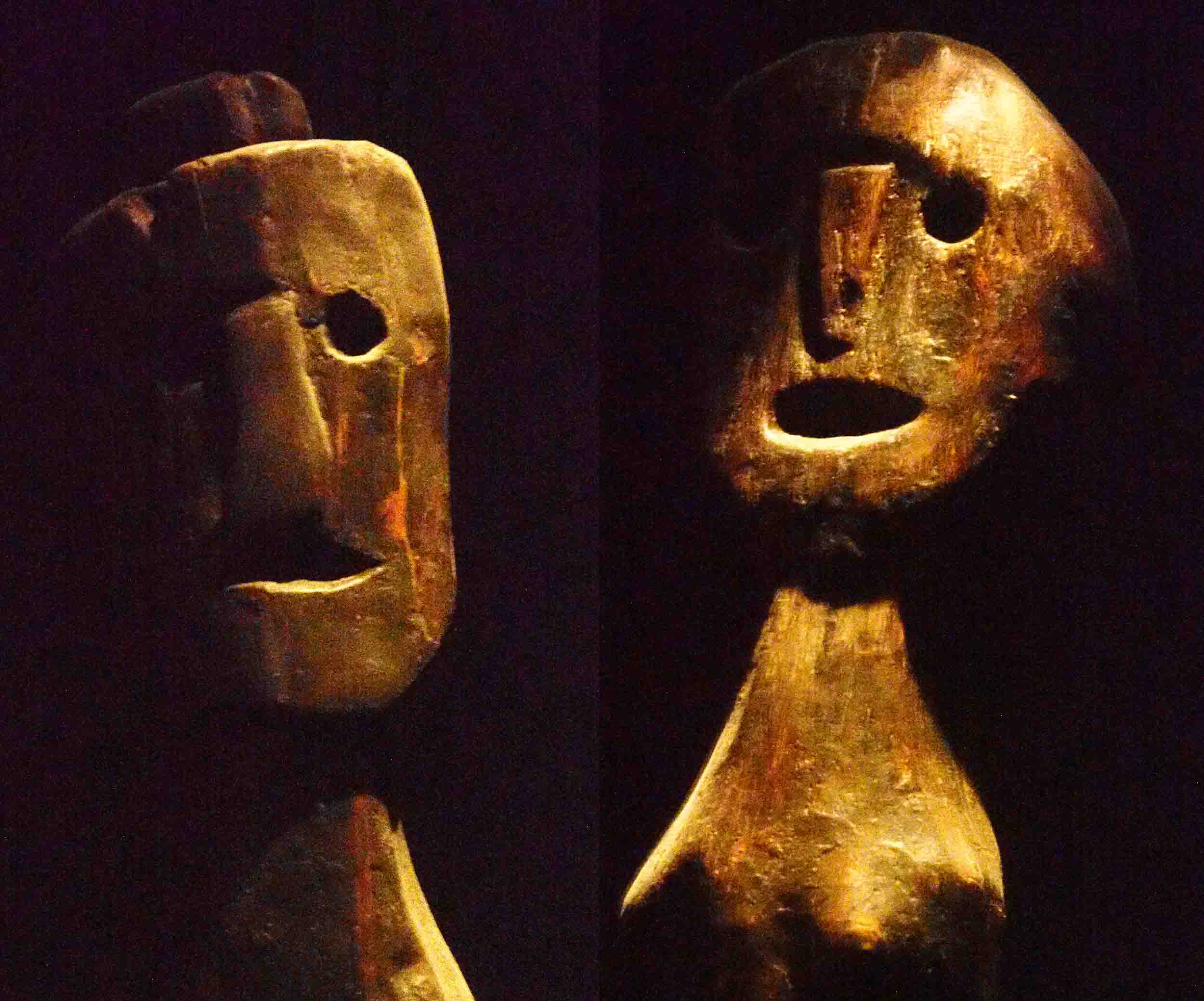
Does ecology give rise to particular cosmologies? In 1947-48, two wooden figures were discovered in peat (apparently just below the surface) of the Aukamper Moor, near the village of Braak (or Bosau, in the Ostholstein district of Schleswig-Holstein). That’s about a hundred km north-east from Hamburg. The find-spot was apparently on “a tiny islet” in a “kleine Kesselmoor” (Aldhouse-Green, 2004). This is the German term for a ‘Kettle hole bog’, which are small features (often smaller than one hectare in size) formed on “young glacial landscapes” when “melting of buried ice blocks from the last ice age creates depressions in which water later collects” (MoorIS). Aldhouse-Green (2004), wrote that the two images were “very explicitly male and female”, larger than life (the male is 275 cm tall), and both images are made from a “carefully selected single bifurcating branch”.
The ‘Braak figures‘ were from wood “felled in the early 4th century” (Hansen, 2010), and erected at a spot where multiple fires had been built between about 400 and 200 BC (van der Sanden and Capelle, 2001. The date places them into the ‘pre Roman Iron Age’ and in the very broadest archaeological sense, associated with the ‘Jastorf’ cultural horizon, or its periphery. At this time, human habitation in North Europe was scattered- ‘villages’ seem not to have existed, rather just ‘hamlets or farmsteads. Human sacrifice was practised – the famous ‘bog-bodies’, placed in various kinds of wetland (Giles, 2020). This is an important context for the Braak figures. Until fairly recently, forests and ‘sacred groves’ figured prominently in our understanding of pre-Christian European religions. This was partly due to the comments of some classical authors, such as Tacitus. Sacred groves certainly existed, and place names that include ‘nemeton’ are generally interpreted this way. However, over the past few decades, forests seem to have lost ground to a revised view – more like “sacred wetness”. There is now an appreciation of wetlands as some sort of ‘cosmological threshold’ – what some call ‘liminal regions’.
The Braak figures are now on display in the Archaeological State Museum in Gottorf Castle in Schleswig (northern Germany). In 2025, along with my friend Nathalie, who comes from Schleswig, we went to see them. After getting over my immediate surprise – how big they are (it’s one thing to read measurements, but another to come face to face with them), I came away, wanting to know more about how they fitted into the bigger scheme of things. And down I went, into another rabbit-hole.
But first, where, exactly, did the Braak figures come from? Where is the Aukamp Moor? It doesn’t seem to be readily Googlable… This was infuriatingly hard to pin down, until I found a blog post by Daniela Parr on her blog site ‘Godeweg’. She too, had gone looking for it, and indicated it was betweem Eutin to Braak, and about a kilometer past a triple-junction to Klenzau, Braak, and Gothendorf. It was “inconspicuously nestled in a meadow” and has “old, venerable black alders and the white birches, some of which stand in the water”.
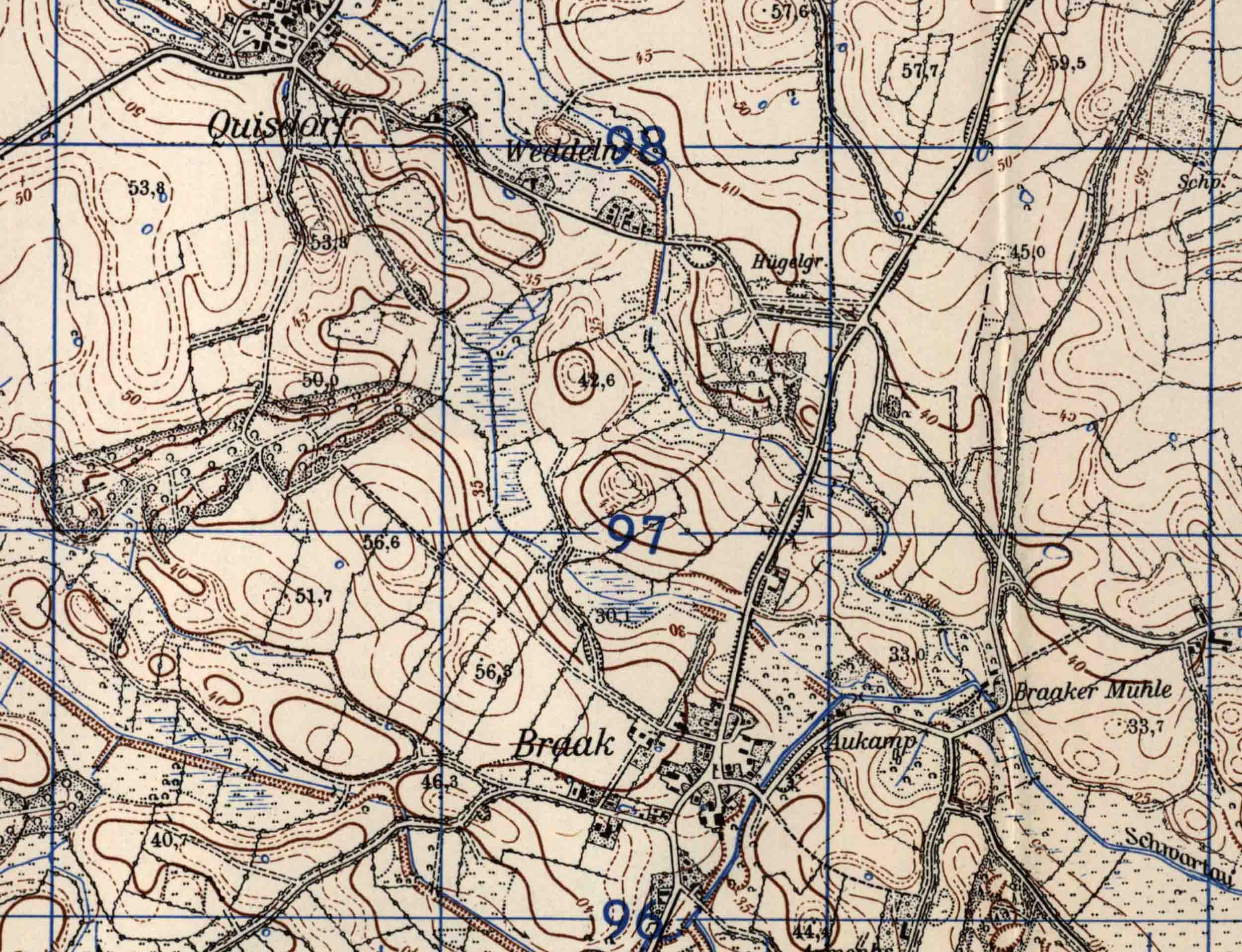
The location of ‘Aukamp’, just east of the village of Braak, on the Germany 1: 25,000 topographic map ‘Eutin’ (1951). Public Domain, Courtesy Harold B. Lee Library, Brigham Young University. One kilometer grid.
Parr’s comments were enough for me to finally spot an ‘Aukamp’ on the Germany 1: 25,000 topographic map ‘Eutin’ (1951). That sounds near enough for me – it’s about 300 m NE of Braak, and beside the Schwartau River. It falls within the ‘Schleswig-Holstein Uplands’ (Schleswig-Holsteinisches Hügelland) of the North German Plain (Norddeutsches Tiefland), with many small lakes and the long, deep embayments (Förde) formed by the moraines of the Weichselian Ice Age.
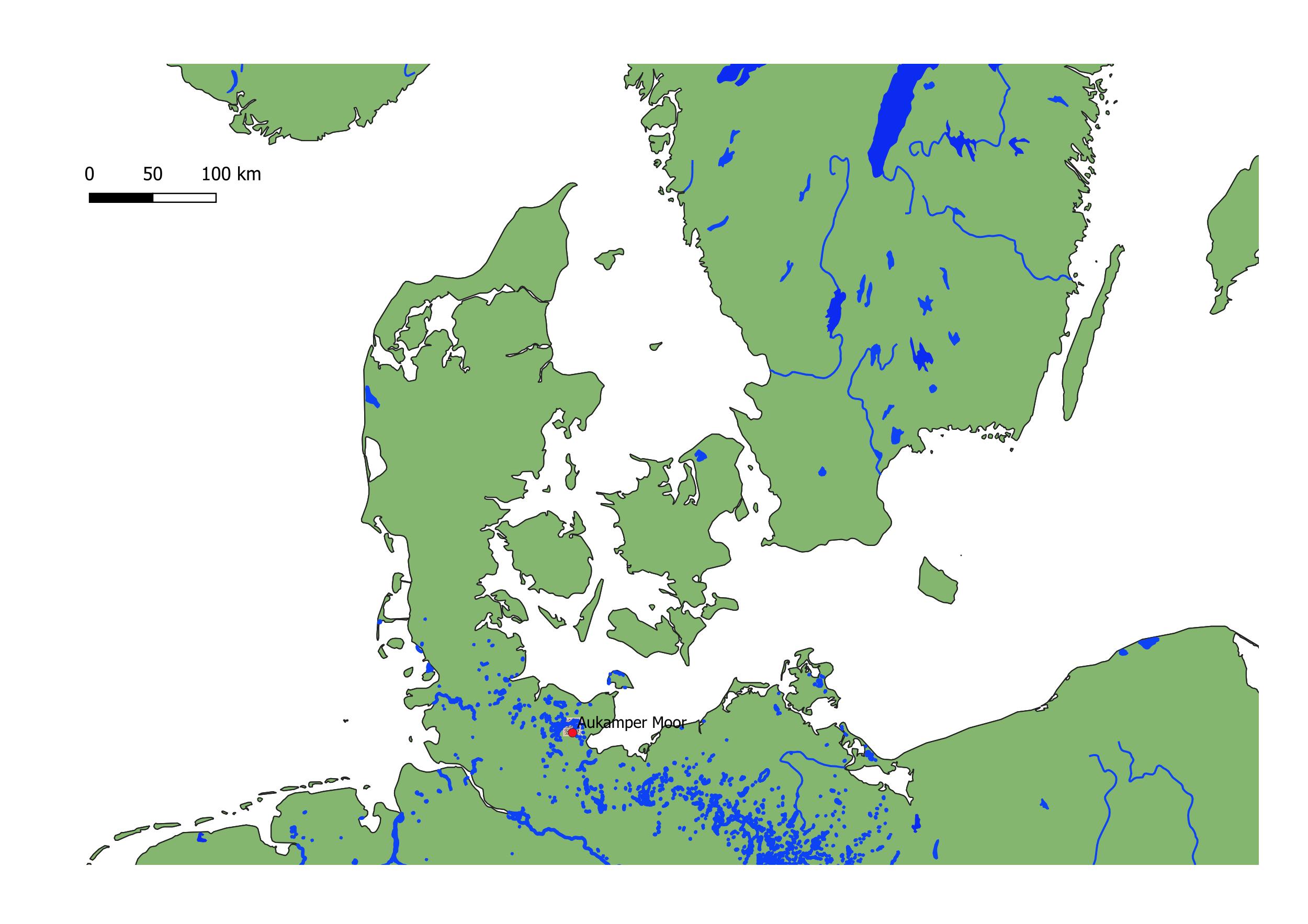
The broader location of the Aukamper Moor (red dot), where the Braak Figures were found. Far northern Germany, a little south of Denmark. A region of multiple small lakes (blue). Map: the author (Mike Pole).
It turns out that there are many other similar wood figures. They have been found clear across northern Europe, from Britain and Ireland (Coles, 1990) and on to Siberia (Chairkina, 2014). They tend to have a unifying straight brow and nose, like a T, and, if they have any at all, simple eyes. These minimal features give them a grim, or ‘spooky’ countenance. The highly simplified faces of these figures had nothing to do with a ‘primitive lack of skill’. The people who made these would have been highly proficient wood workers, and the crude redition – a kind of deliberately incomplete body – was likely exactly what the makers were aiming for, aiming for over an enormous area of ‘Eurasia’, and for a very long time – the far older ‘Shigir idol’ from Siberia (with that same ‘grim’ visage), is around 10,000 years old (Terberger, et al., 2021). So many of these figures are now known, that one author (Behm-Blanke 2003:89ff) has divided Central and Northern European wooden idols into five types (including ‘grenklykeidoler’ – Swedish for ‘branch-like idols’).
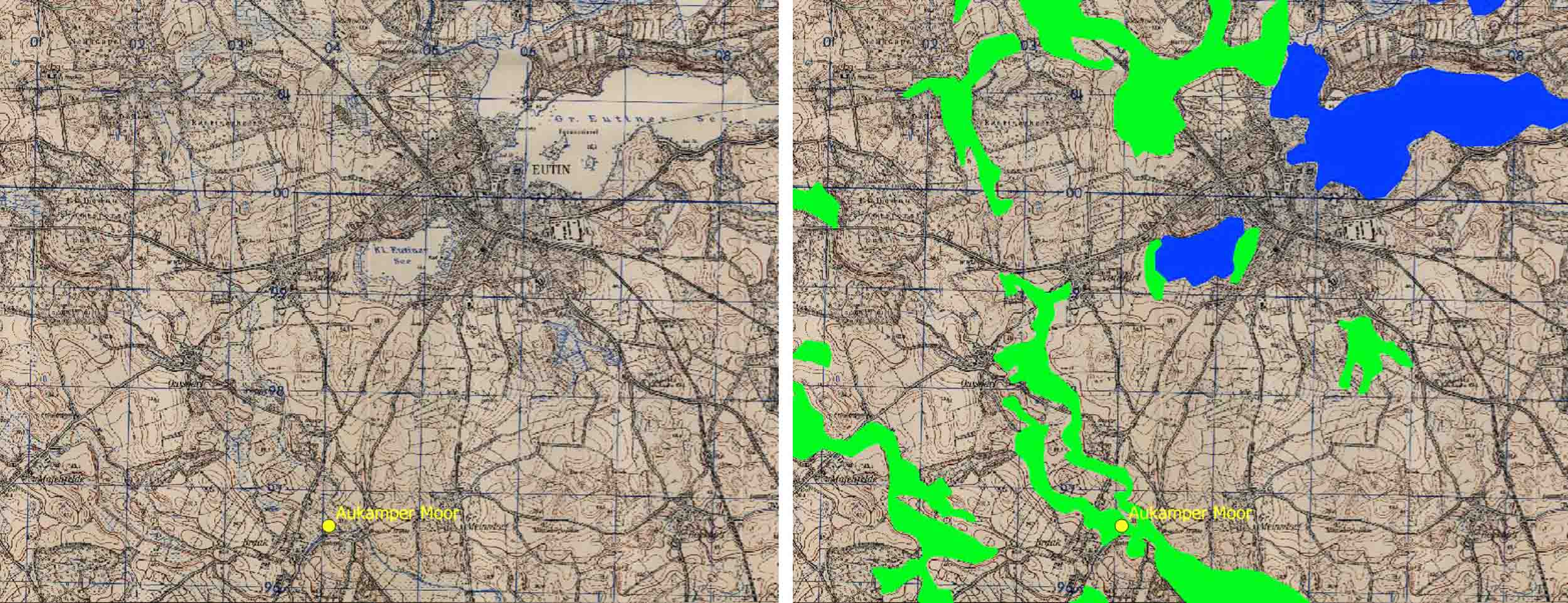
Left: The location of the Aukamper Moor (yellow dot) on the Germany 1: 25,000 topographic map ‘Eutin’ (1951). Right: the same view, but with the addition by the author of blue, representing lakes, and green, as low-lying areas of swampy floodplain and bogs. Topographic map in the Public Domain, Courtesy Harold B. Lee Library, Brigham Young University. Additions by the author, Mike Pole.
What is going on here? At the same time as northern Europeans were setting up spooky wooden figures around cool, misty bogs, the southern Europeans (think Greece-Rome), in complete contrast, were carving human images in stone, trying to make them as life-like as possible, and setting them up in very ordered buildings in a much warmer and drier climate (Kiernan, 2020, puts the Iron Age figures into context with Roman figures).
This distribution is just a fragment of a fascinating pattern of human figure represention. One could point to another style of anthropoid figure – the Palaeolithic ‘Venus’ figures, once produced very widely across Eurasia. They were made in a totally different environment, one of cold steppe and tundra, and had their own quirks – fairly detailed bodies, but lacking faces. In fact, there were times and places across Eurasia, when making human figures of any type, seems to have been completely ‘taboo’ (Iversen, et al., 2024).
Anthropologists have become fond of using the word ‘liminal’. A liminal landscape is one where boundaries, like between ‘wet’ and ‘dry’, are blurred. A very broad view could frame the entire ancient northern European world – a post-glacial region of low-lying marshes, swamps, peat wetlands and more forest than today (Kaplan, et al., 2009) – as an essentially ‘liminal’ landscape. It could be contrasted ecologically and climatically, with the Mediterranean to the south (where the Roman Empire was developing) and was virtually the antithesis of ‘liminal’. One can also use the word ‘liminal’ to describe the Iron Age wooden figures that turn up in bogs. They are not quite human – but distant from any attempt at representing someone ‘real’.
Did those broad geomorphological and ecological settings have had cultural and world-view implications? Could the cosmology of liminal northern-Europe and the anti-liminal Mediterranean be opposites? To some extent, ecology does influence religion (e.g. Botero, et al.. 2014), but it obviously doesn’t translate directly into cosmology – much the same ‘liminal’ landscapes still exist across northern Eurasia, but Christianity has, mostly, replaced whatever cosomology there was. Cultural values have over-ridden forces of ecology. In the south, the individual became important, and likewise, a lasting representaion of a particular person, placed in an ordered permanent structure – or at least, one that was hoped to be permanent. The north Europeans had different ideas – don’t represent anyone in particular, make it in wood, and set it up in a place where the living ground will eventually swallow it. Up there, individuals may not have been so important.
The general practise of constructing wooden effigies, an erecting them in northern European bogs, apparently ceased around AD 500. There may have been more than one reason for this, but the spread of Christianity into the region was likely the final death-knell. Lapland, in the far north, was one of the last European areas to be Christianised, and extraordinarily similar figures to those of the Pre-Roman Iron Age are known from its historical past (Madsen, 2023). There are written records from the 17th century, describing what are surely the same things. Christianity – which could be seen as a kind of anti-liminal force – really had it in for them. But the physical context is quite different – the Sami figures were placed in special “sacrificial” sites, (known as ‘sieidi’ in North Sámi), but in general, these weren’t wetlands.
However, we may have ‘just’ missed a wonderful opportunity to further understand the mind-set of those wetland-revering north Europeans. No, we probably shouldn’t go back to sticking bodies in bogs, but it is time we regained some respect for those liminal places.
References
Aldhouse-Green, M. 2004. An Archaeology of Images. Iconology and cosmology in Iron Age and Roman Europe.
Behm-Blancke, G. 2003. Heiligtümer der Germanen und ihrer Vorgänger in Thüringen. Die Kultstätte Oberdorla. Forschungen zum alteuropäischen Religions- und Kultwesen. Teil 1 Text und Fototafeln. Mit Beiträgen von Helga Jacob, Herbert Ullrich und Hans Eberhardt. Thüringschen Landesamt für Archäeologische Denkmalpflege dursch Sigrid Dušek. Weimarer Monographien zur ur und frühgeschichte, Band 38, 1. Stuttgart: Kommissionsverlag. Konrad Theiss Verlag.
Botero, C.A., Gardner, B., Kirby, K.R., Bulbulia, J., Gavin, M.C. and Gray, R.D. 2014. The ecology of religious beliefs. Proceedings of the National Academy of Sciences, 111:16784-16789.
Chairkina, N.M. 2014. Anthropomorphic wooden figures from the Trans-Urals. Archaeology Ethnology & Anthropology of Eurasia, 42: 81–89.
Coles, B. 1990. Anthropomorphic Wooden Figures from Britain and Ireland. Proceedings of the Prehistoric Society, 56: 315-333 doi:10.1017/S0079497X0000517X
Giles, M. 2020. Bog bodies. Face to face with the past. Manchester University Press.
Hansen, S. 2010. Archaeological finds from Germany Selected and annotated. Booklet to the Photographic Exhibition. Deutsches Archäologisches Institut, Eurasien-Abteilung. Berlin.
Iversen, R., Becker, V., and Bristow, R. 2024. Figurative Representations in the North European Neolithic—Are They There? Cambridge Archaeological Journal, 1-19.
Kaplan, J.O., Kristen M. Krumhardt, K.M., and Zimmermann, N. 2009. The prehistoric and preindustrial deforestation of Europe. Quaternary Science Reviews, 28: 3016–3034
Kiernan, P. 2020. Roman Cult Images: The Lives and Worship of Idols from the Iron Age to Late Antiquity.
Madsen, C.L. 2023. Samiske træguder. heimskringla.nohttps://heimskringla.no/wiki/Samiske_tr%C3%A6guder
Terberger, T., Zhilin, M., and Savchenko, S. 2021. The Shigir idol in the context of early art in Eurasia. Quaternary International, 573,:14-29.
Van der Sanden W., Capelle T. 2001 Mosens guder: Antropomorfe traefigurer fra Nord- og Nordvesteuropas fortid. (Immortal Images: Ancient Anthropomorphic Wood Carvings from Northern and Northwest Europe). Silkeborg: Silkeborg Museum. (I haven’t managed to get a copy of this paper)