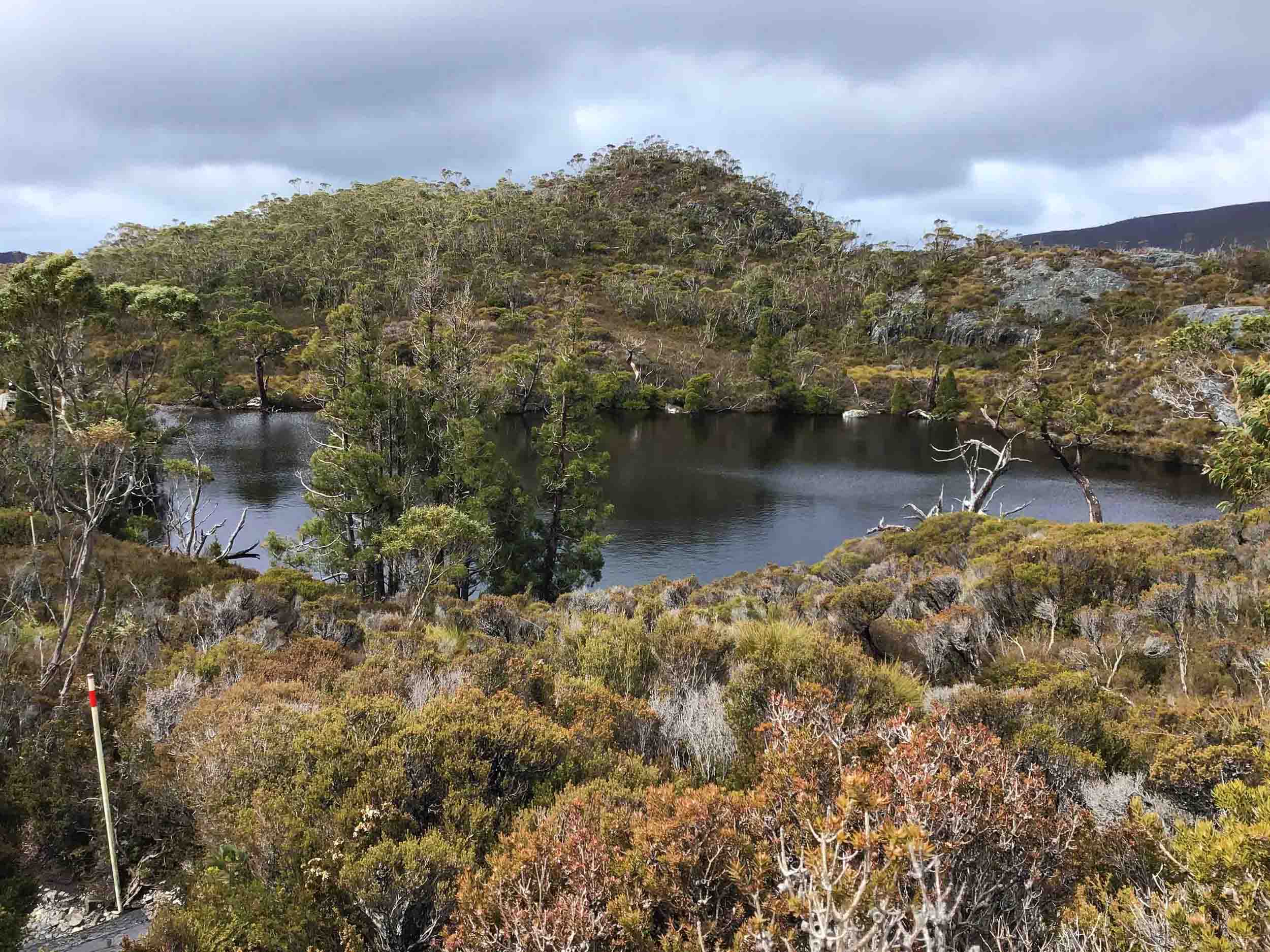
Sitting a little above the more famous lake of Cradle Mountain National Park , Tasmamia – Dove Lake, is Wombat Pool. Some tourists are confused by the name – assuming its a good place to see wombat. It’s perhaps not a good idea to tell them it was named by a pioneer of the park, Gustav Weindorfer – after he killed and ate a wombat there.
The most photogenic elements are the ancient Pencil Pines growing on the edge of the lake, right on the water line. Their diameter suggests they are several centuries old. One could infer that these are the tiny remnants of a broader extent of rainforest – reduced by fire to the very edge of the water, until these few trees are the only ones that have managed to hold out against the flames. Other than the Pencil Pines, Wombat Pool sits within a sea of very different vegetation. In technical terms, Kirkpatrick and Balmer (1991) mapped this broader region as Eucalyptus coccifera woodland/open forest, Eucalyptus subcrenulata open forest, and Heathy Sedgeland. More recent state-wide mapping of Tasmania’s vegetation (TasVeg 5.0: Kitchener and Harris, 2013) shows a thin strip of RPW (Arthrotaxis cupressoides open woodland), a type of rainforest, right around the lake, and a much broader area of MBS (Buttongrass moorland with emergent shrubs) and DCO (Eucalypus coccifera forest and woodland).
In contrast to the tiny bit of ‘rainforest’ encircling Wombat Pool, the surrounding vegetation is fire-tolerant, fire-promoting, or even ‘pyrophyllic’ (e.g. Jackson, 1968; Bowman, 2000). One doesn’t have to look far to find evidence of fires (like fire-scarred trunks) within it – and even on the trunks of the pencil pines (which managed to survive). Jackson (1972) wrote that woodland of the two Eucalyptus species around Wombat Pool “occurs as a mosaic with conifers where exposure and drought increase the risk of fire and eventually replaces the conifers if the fire frequency approaches one fire every 70 to 100 years”.
So just ‘eyeballing’ the surrounding vegetation, one can get a broad picture of what has gone on over the past few centuries. Fire has removed rainforest, and repeated fires have reduced it down to just a few trees, right at the waters edge. Those fires have promoted fire-tolerant vegetation, which now dominates the area. But to really get to grips with the history of Wombat Pool, a fossil history of its sediment is needed – and a group of scientists have done just that (Stahle et al., 2016). They extracted a ‘core’ of mud and peat from the middle of Wombat Pool. From this record of sediment, just over three meters long, they were able to extract, at intervals, fossil pollen and spores, charcoal fragments, and get some radio carbon dates.
The oldest carbon dates indicate that Wombat Pool began in the Late Glacial period, about 17,000 years ago – just after the ice mass that occupied the valley began to melt. The climate, of course, was cold, and the earliest vegetation was of alpine and moorland communities. As conditions warmed, the vegetation biomass – a mosaic of grass, buttongrass, sclerophyll woodland and rainforest, increased. Fires were present, presumably periodically burning the non-rainforest – and peaked around 10,990 to 9400 years ago.
Behind this increase in fire activity lay “higher-than-present winter and annual temperatures” which led to a longer growing season, an increased ‘fuel biomass’. Humans had clearly been in Lutruwita/Tasmania for many thousands of years before Wombat Pool began to form (one of the latest works, Adeleye, et al., 2024, argues people had arrived in Tasmania by 41,600 years ago), but their presence, and impact as ignition sources, appear to have been minimal at this time. The increase in burning seems to have been a natural outcome of climate and vegetation change interacting with lightening-induced fires.

A broader view of Wombat Pool, Cradle Mountain National Park, Tasmania – looking over it from above, with the Rony Creek car park and bus stop in the distance. Photo: the author (Mike Pole)
As climate continued to change, between around 9,000 and 4,500 years ago, the combination of temperature and rainfall resulted in ‘relatively high effective moisture’. The consequence of this (and the apparent continued absence of people) was that montane rainforest (including pencil pine and Nothofagus beech) reached a maximum, and fire, a minimum. In this period, some Eucalyptus pollen was blowing into Wombat Pool, although its origin is not discussed. Presumably it comes from Eucalyptus vegetation somewhere distant, elsewhere in Cradle Valley.
Then something major happened. About 3,600 years ago, the charcoal in the Wombat Pool core suggests that “one or more large or severe fires” occurred, which significantly impacted the vegetation. Rainforest pollen diminishes, and Eucalyptus “became dominant”. The climate had become cooler and drier, and humans had either re-populated the area, or altered their ‘subsistence strategies’ to become more apparent in the archaeological record. As Stahle et al. (2016) put it, humans “may have become a significant ignition source that was lacking during the previous ca. 7000 years”.
This conflagration (or series of) appears to have been a major factor eliminating rainforest from around Wombat Pool, and “provided and opening for Eucalyptus and other wet sclerophyll forest plants”. In other words, that particularly fiery period 3,600 years ago seems to have “created a threshold” (Stahle et al., 2016) – whereby the generally phyrophobic and fire-inhibiting rainforest, was “pushed” into a more fire-prone and pyrophyllic one. With the breaching of this threshold, fires would have been more probable, and tended to at least perpetuate, and probably expand the more fire-prone vegetation. One might say that the system had crossed a ‘tipping-point’.
None of the individual plants around Wombat Pool will be as old as that fire. It will have been repeated fires since 3,600 years ago, that would have further reduced rainforest down to those last few trees. But in regards to the dominant vegetation around the lake, we are likely seeing the consequences of that fire over three millennia ago.
References
Adeleye, M.A., Hopf, F., Haberle, S. G., Stannard, G.L., Mcwethy, D.B., Harris, S., and Bowman, D.M.J.S. 2024. Landscape burning facilitated Aboriginal migration into Lutruwita/Tasmania 41,600 years ago. Science Advances, 10, eadp6579 (2024).
Bowman, D.M.J.S. 2000. Australian Rainforests: Islands of Green in a Land of Fire. Cambridge: Cambridge University Press.
Harris, S and Kitchener, A. 2005. From Forest to Fjaeldmark: Descriptions of Tasmania’s Vegetation. Department of Primary Industries, Water and Environment, Printing Authority of Tasmania. Hobart.
Jackson, W.D. 1968. Fire, air, water and earth – an elemental ecology of Tasmania. Proceedings of the Ecological Society of Australia, 3, 9-16. doi: https://doi.org/10.5860/choice.48-6209
Jackson, W.D. 1972. Vegetation of the Central Plateau. Papers and Proceedings of the Royal Society of Tasmania, 106: 61-86. doi: https://doi.org/10.26749/rstpp.106.1.61
Kirkpatrick, J.B. and Balmer, J. 1991. The Vegetation and Higher Plant Flora of the Cradle Mountain–Pencil Pine Area, Northern Tasmania. In: Aspects of Tasmanian Botany: A Tribute to Winnifred Curtis (eds. Banks et al.). pp. 119–148. Royal Society of Tasmania.
Kitchener, A. and Harris, S. 2013. From Forest to Fjaeldmark: Descriptions of Tasmania’s Vegetation.
Edition 2. Department of Primary Industries, Parks, Water and Environment, Tasmania.
Stahle, L.N., Whitlock, C., and Haberle, S.G. 2016. A 17,000-Year-Long Record of Vegetation and Fire from Cradle Mountain National Park, Tasmania. Front. Ecol. Evol. 4:82. doi: 10.3389/fevo.2016.00082