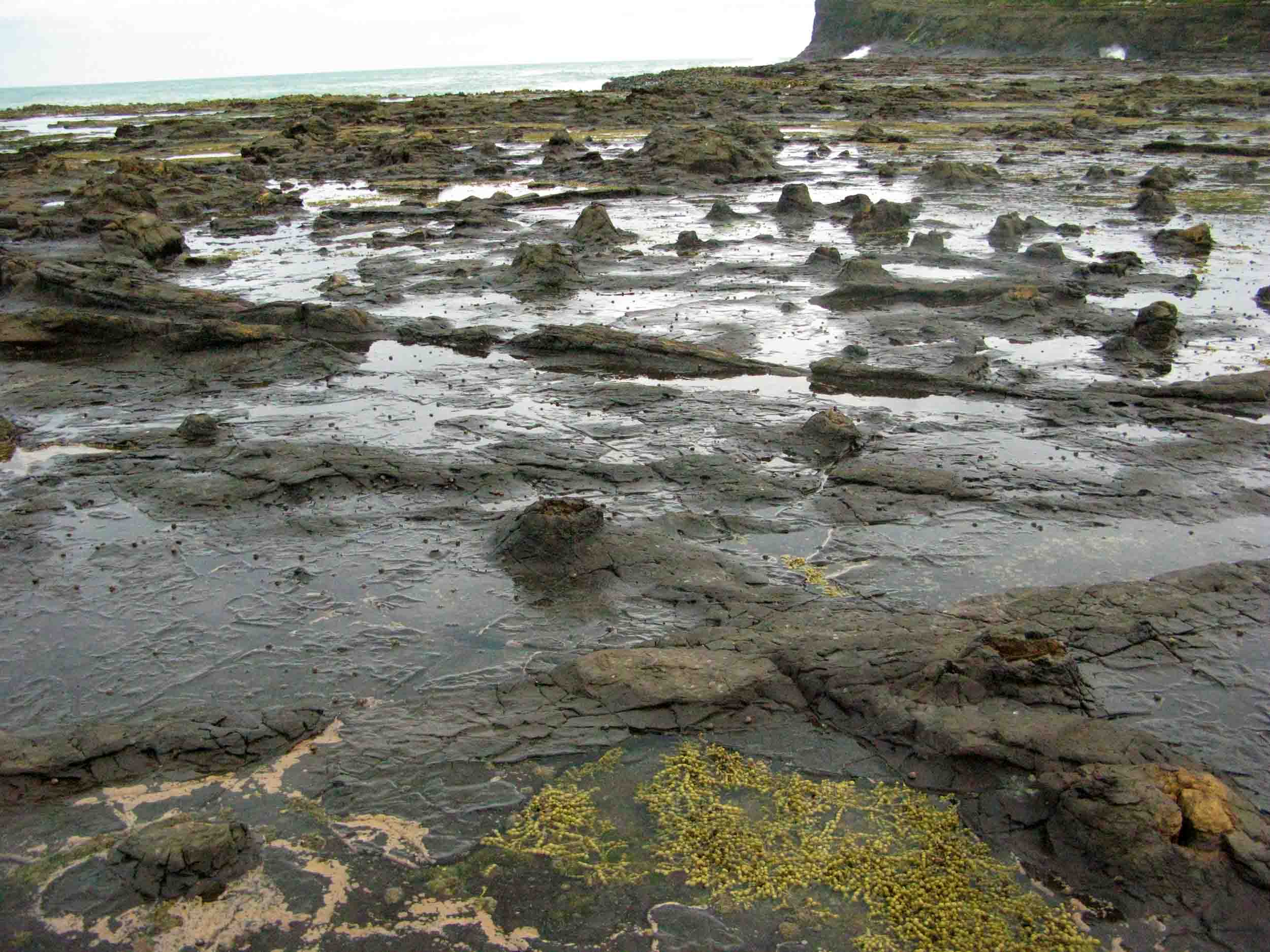
This series brings together posts exploring the Jurassic fossil forests at Curio Bay, southermost New Zealand – from the in-place stumps of the actual forests, to the various plant species that grew in it, to a broader view of the landscape and its soils, and even possible dinosaur activity. If you want to learn more about New Zealand’s famous fossil forests – and particularly if you are thinking of visiting Curio Bay, or have already been, and want to know more about what you saw, this series will guide you through. The series will grow with future posts….
A. Forest Structure
1 . New Zealand: The Jurassic fossil forest at Curio Bay
Very near the southernmost point of the South Island of New Zealand, lies a famous fossil forest (in fact, there are several layers of forests).
2. The Biggest Tree Stump in the Curio Bay Jurassic Forest
The fossil forest has a range of stump sizes, but one stump rules them all.
3. How Tall were the trees in New Zealand’s Jurassic Fossil Forest at Curio Bay?
Other than the minimum tree heights indicated by actual logs, there are ways to estimate height from stump diameter.
4. The Hollow Tree Stumps at Curio Bay
A curious thing about the fossil tree stumps at Curio Bay, is that some of them seemed to be hollow when they were buried.
B. The Players – differnt plants that grew in and around the forest
5. Horsetail Marshes of the New Zealand Jurassic
There are no horsetails in New Zealand today, but they were promiment in some situations in the Jurassic.
6. Globalisation in the Jurassic – the fossil fern Coniopteris in New Zealand
Seems like in the Jurassic, a lot of the plants spread all over the world.
7. Cladophlebis – New Zealand’s Mesozoic Weed
If there’s a Jurassic fossil plant location in New Zaland – this fern is usually there!
8. Palissya – mysterious cone of New Zealand’s Jurassic forests
One of the relatively common fossils around Curio Bay, is also one of the most enigmatic.
9. Podozamites – a multi-veined conifer in New Zealand’s Jurassic
One of the trees at Curio Bay was somewhat similar to the kauri – in having leaves with multiple veins.
10. Deciduous Conifers in New Zealand’s Jurassic Fossil Forest at Curio Bay
Today, most of New Zealand’s plants are evergreen – and all of our conifers. But in the Jurassic, it seems we had at least one deciduous conifer.
C. Signs of Animal life
11. Bioturbation near the Jurassic Fossil Forests at Curio Bay
A couple of sedimentary layers at Curio Bay have been burrowed, by …. something.
12. Dinoturbation at Curio Bay Jurassic Forest?
No dinosaur bones are known from the Jurassic of New Zealand, but Curio Bay might have footprints.
13. Were there dinosaurs in New Zealand’s Jurassic Fossil Forest at Curio Bay?
Natural processes can make strange patterns in wet sediment. Sometimes telling them from footprints is not easy.
D. The Landscape
14. Three Kinds of Volcanic Ash around the Jurassic Fossil Forests of Curio Bay
Look closely, and in, or around Curio Bay, and ‘Crystal’, ‘Vitric’, and ‘Lithic’ tuffs (volcanic ashes) are present.
15. The Jurassic fossil soils of Curio Bay, and Fortrose-Otara, New Zealand
Curio Bay has fossil trees – but what kind of soil were they growing in, and what can the soil say about the climate?
16. How Much Carbon Dioxide was in the Atmosphere of New Zealand’s Jurassic Curio Bay Fossil Forest?
Carbon Dioxide levels in the Jurassic were probably far higher than today.
17. Where was the Murihiku in the Jurassic?
Curio Bay is part of the collage of ‘terranes’ that have become modern-day New Zealand. But where did it first form?
18. What latitude did the Jurassic Fossil Forest of Curio Bay grow at?
Did the Curio Bay forests grow above or below the Polar Circle?
E. History
Edward and Agnes Arber were two prominent scientists in the UK. Edward produced a huge work on the fossil plants of New Zealand, then died young. His wife went on to publish some influential works of Botany.